
In modern electrical systems, connection reliability is just as critical as the components themselves. Choosing the right terminal affects safety, installation efficiency, maintenance costs, and overall project quality.
The two most widely used connection types today are spring clamp terminals and push-in terminals. Although both rely on spring clamping mechanisms, they differ significantly in wire compatibility, installation method, and application scenarios.
So, which is better—spring clamp or push-in terminals? This guide provides a comprehensive comparison of their differences, advantages, and ideal applications.
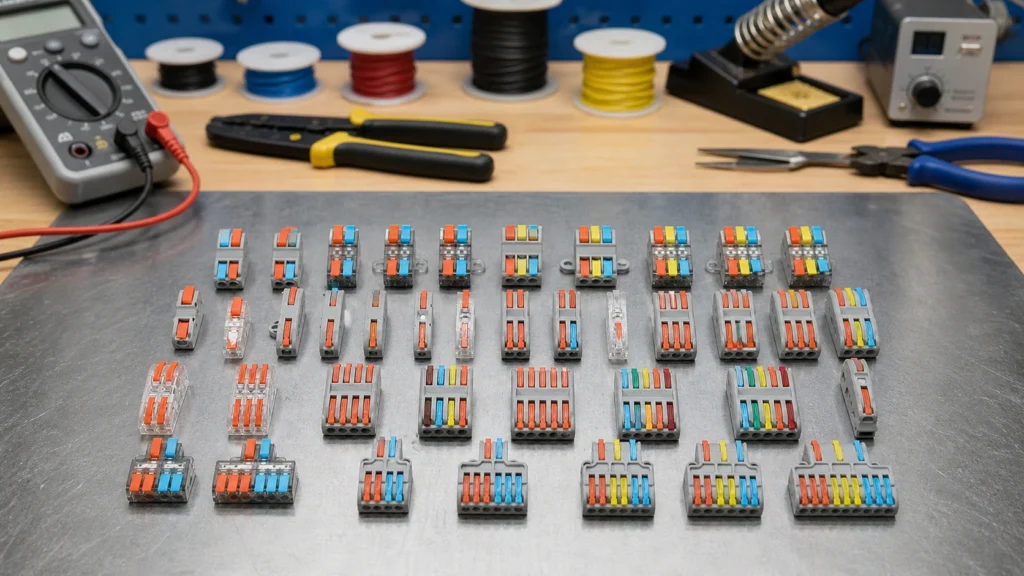
What Is a Spring Clamp Terminal
A spring clamp terminal is a screwless connection device that uses a cage spring mechanism to securely clamp wires, ensuring reliable electrical contact.
Definition and principle of spring cage terminal
It uses a tensioned cage spring mechanism. The wire is inserted after pressing the spring, and once released, the spring applies uniform pressure to create a gas-tight connection.
Main features of spring cage type terminals
Installation: Requires pressing the spring; compatible with solid, stranded, and fine-stranded wires (ferrules optional)
Reliability: Excellent vibration resistance with long-term stability
Advantage: Saves about 50% installation time compared to screw terminals
What Is a Push-in Terminal
A push-in terminal is a tool-free connection type where wires are inserted directly to establish electrical contact.
Definition and principle of push-in terminals
It features an internal spring clamp that automatically locks the conductor upon insertion, forming a secure connection.
Main features of push-in terminals
Speed: Up to 3× faster than screw terminals
Wire type: Solid wires or ferruled stranded wires
Reliability: Secure, vibration-resistant connection
Key Differences
| Feature | Spring Clamp Terminal | Push-in Terminal |
| Installation | Press to insert | Direct push |
| Tools | Required | Tool-free |
| Wire Compatibility | All types | Solid / ferruled |
| Vibration Resistance | Excellent | Good |
| Speed | Fast | Fastest |
| Current Rating | Higher | Moderate |
| Application | Industrial | Quick wiring |
Wire Range & Compatibility
These terminals use different spring mechanisms to fix the wires; the spring cage type emphasizes uniform pressure, while the push-in type focuses on the convenience of direct insertion.
| Feature | Spring Clamp Terminal | Push-in Terminal |
| Conductor Cross Section | 0.08-2.5 mm² (standard); up to 0.5-10 mm² (large sizes) | 0.25-4 mm² (typical); solid wire 0.5-6mm² |
| AWG Range | 28-14 AWG (standard); 20-8 AWG(extended) | 24-12 AWG |
| Solid Wire | Excellent, fully compatible across therange | Excellent, best for direct insertion |
| Stranded Wire | Excellent, no ferrule required; goodcompatibility with fine strands | Moderate, requires ferrules or sleeves |
| Fine-stranded / Multi-stranded Wire | Excellent, uniform clamping by cage spring | Limited, may loosen without ferrules |
| Max Current | 24-41 A (depending on model) | 32 A (typical) |
Spring cage type is more suitable for complex wire environments, while push-in type emphasizes quick solid wire connection.
Maintenance & Lifespan
Spring clamp terminals and push-in terminals both outperform screw terminals in terms of maintenance convenience and lifespan. The former is maintenance-free and highly durable.
Maintenance Method
Spring clamp terminals require a screwdriver to press the release slot and remove the wire.
Push-in terminals use a small tool (such as a release pin) inserted into the release hole to disconnect the wire.
Both methods are simple and fast, helping reduce downtime.
Lifespan & Durability
Both designs use spring mechanisms to ensure long-term, reliable contact.
Spring clamp terminals typically offer more than 3,000 insertion cycles per spring, meeting fatigue test standards, and can operate for decades without loosening.
Push-in terminals provide similar maintenance-free performance, with strong resistance to vibration and temperature changes.
| Aspect | Spring Clamp Terminal | Push-in Terminal |
| Insertion Cycles | 3000 cycles per spring, fatigue-tested | 3000 cycles, similar spring mechanism |
| Maintenance Requirements | Maintenance-free, no periodictightening required; stable undervibration | Maintenance-free, supports quick disconnection; ideal for frequent replacement |
| Service Life | Decades; operates from -40°C to+70°C; corrosion-resistant | Decades; suitable for dynamic systems |
| Common Issues | Rare loosening, easy to inspect | Occasional inspection needed under vibration, but infrequent |
Both reduce long-term costs and are superior to screw terminals, which require regular inspection.
Spring-cage terminals and push-in terminals each have their own applicable scenarios. So, what are their respective applications?
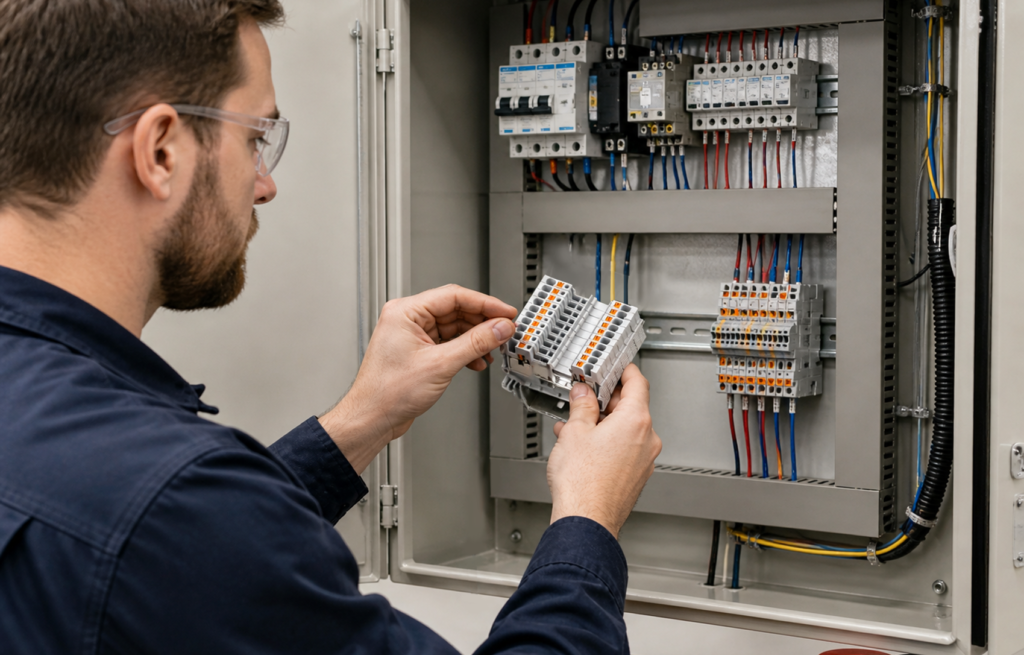
Spring clamp terminals are preferred for high-vibration and impact environments such as railways, elevators, automation equipment, and the chemical industry. They provide excellent anti-loosening performance and uniform clamping force, are compatible with stranded wires without requiring ferrules, and can reduce wiring time by up to 75%.
Push-in terminals are suitable for confined spaces, high-volume assembly, lighting applications, and electrical cabinets. They enable the fastest tool-free installation and are ideal for solid conductors or stranded wires with ferrules. They reduce operating steps but require attention to protection in extreme environments.
In rail transit or instrumentation, spring clamp terminals are more reliable; in distribution box maintenance where speed is critical, push-in terminals are more efficient.
Spring clamp terminals and push-in terminals each have their own advantages. The essential difference is that one emphasizes versatility and stability, while the other focuses on efficiency and ease of use.
The final choice should be based on the conductor type, installation efficiency requirements, and the operating environment—rather than simply judging which one is “better.”
Compact Push Wire Connector – Terminal blocks production and development Manufacturer-Zhejiang ShengLing
Click the link to see more about our products.