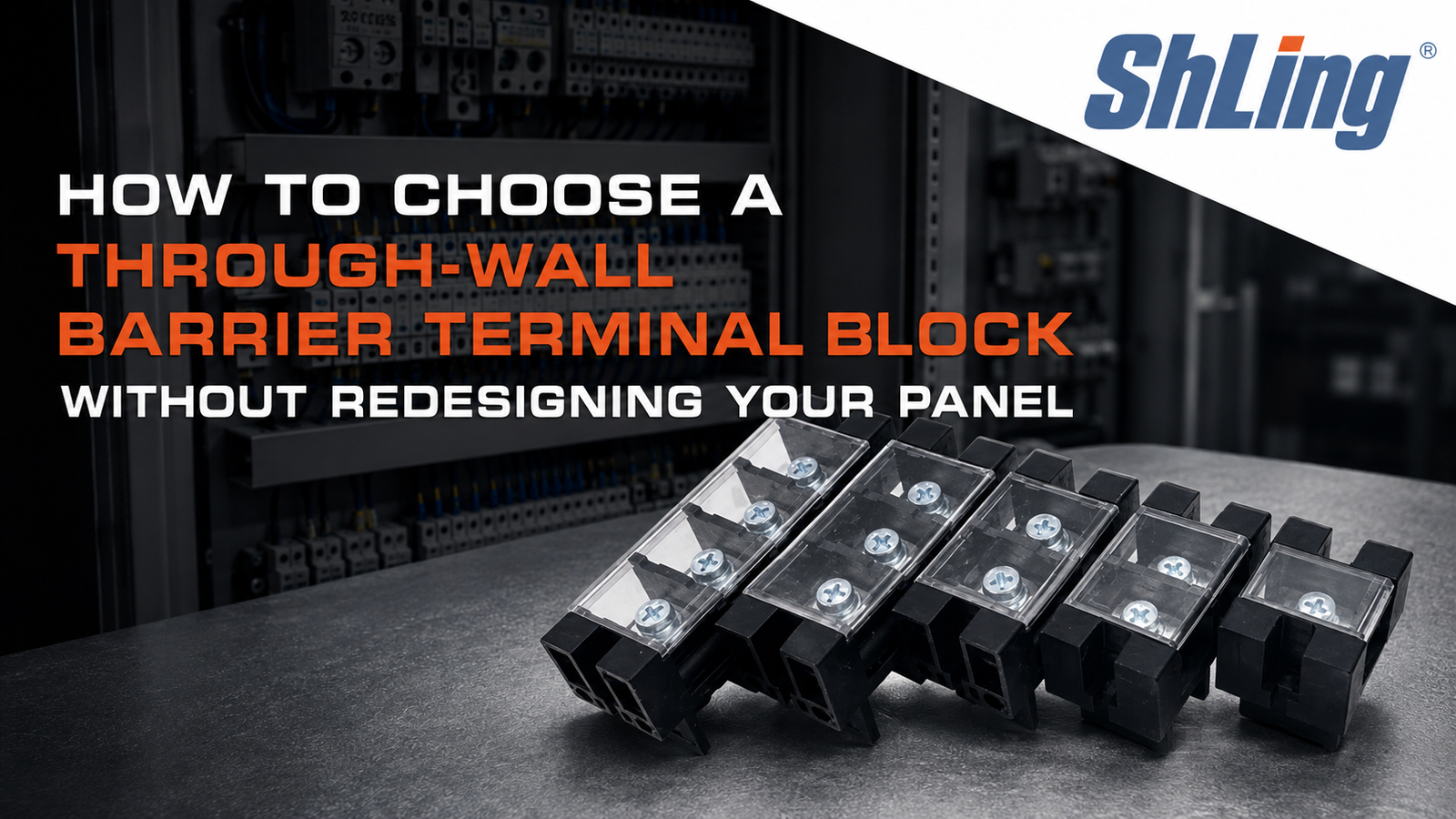
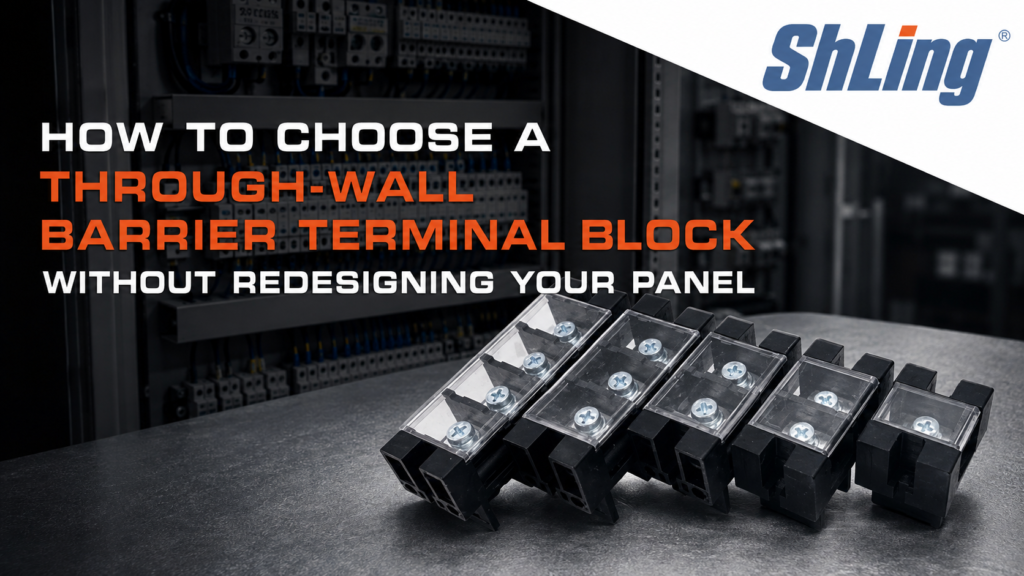
If your enclosure has already been machined, replacing a through-wall barrier terminal block is no longer just a matter of finding a terminal with the same current rating.
A small mismatch in the panel cutout, mounting depth, wire range or terminal spacing can turn a simple component replacement into new drawings, re-machining and production delays.
For OEMs and control cabinet manufacturers, the goal is straightforward: find a replacement that fits the existing panel and wiring requirements with as little redesign as possible.
Quick answer: before changing brands or models, verify five items: panel cutout and thickness, current and voltage rating, wire range, rear installation clearance, and terminal spacing. If these match, you may be able to replace the terminal without changing the enclosure.
Start With the Existing Panel Opening – Not the Product Photo
Two through-wall terminal blocks can look nearly identical in a catalog and still require different panel openings. If the panel is already produced, mechanical compatibility should be your first filter.
Before comparing price or delivery time, confirm these dimensions:
- Panel cutout or mounting opening
- Panel thickness
- Terminal body width and height
- Mounting or locking method
- Installation depth and pole spacing
If any of these dimensions change, the new terminal may require a new cutout or a revised panel drawing. That may be acceptable for a prototype, but it becomes costly when a production batch of enclosures has already been made.
What to ask for from the supplier
Do not rely on a product photo alone. Ask for a dimensional drawing and compare it with your existing panel drawing. If you already have an old terminal, send the model number, a clear photo and the mounting dimensions so the supplier can cross-check the fit before recommending an equivalent.
A Matching Footprint Is Not Enough
A replacement can fit the opening perfectly and still be wrong for the circuit. Mechanical fit and electrical fit need to be checked together.
At minimum, compare:
- Rated current
- Rated voltage
- Applicable wire range
- Conductor type
- Any project-specific safety or certification requirement
A similar housing size does not guarantee the same electrical performance. This is especially important in power supplies, industrial machines and control cabinets where the terminal may carry continuous load current.
A useful sourcing rule is: the alternative must meet the application requirements electrically and fit the existing installation mechanically. Passing only one of those checks is not enough.
Check Wire Entry and Rear Clearance Together
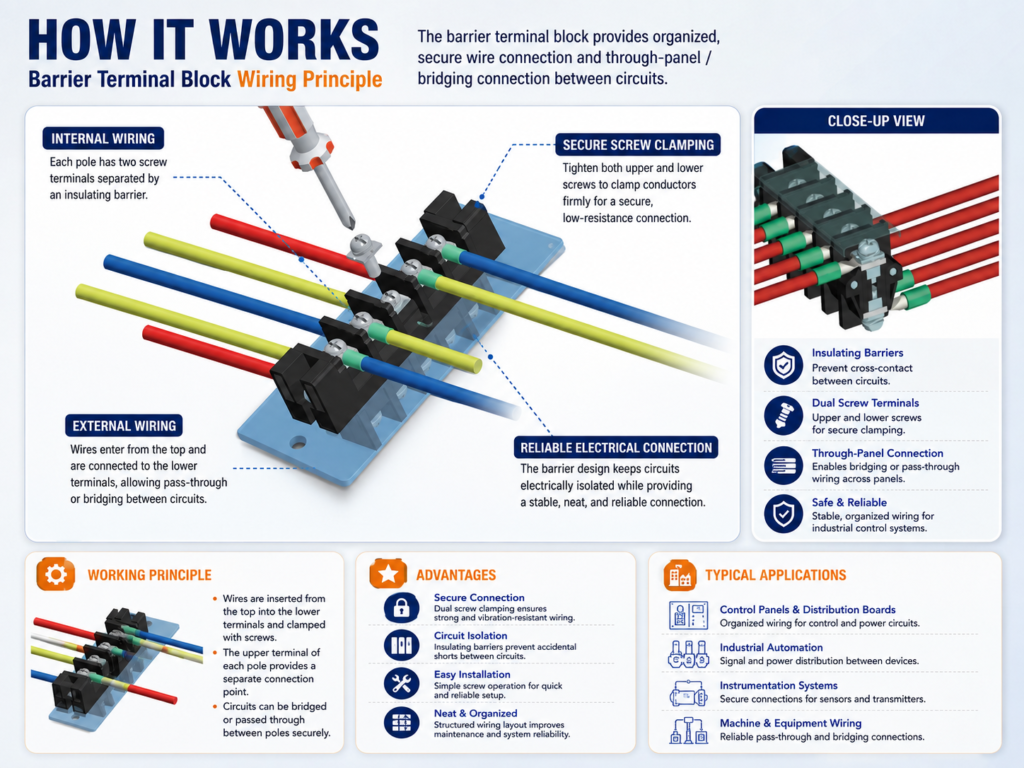
Wire range is often checked separately from cabinet space, but in practice the two are connected.
For example, a terminal may accept the required conductor size, yet the cable still needs enough room behind the panel to enter the terminal and bend without interfering with other components.
Before ordering, confirm both the conductor specification and the space around the connection point:
- Actual wire size in mm² or AWG
- Solid, stranded, flexible or ferrule-terminated conductor
- Rear terminal depth
- Distance to DIN rails, cable ducts and nearby devices
- Enough access for wiring and tightening or operating the connection
This check matters most in compact equipment. A terminal can be correct on paper but still be difficult to wire if the rear clearance is too tight.
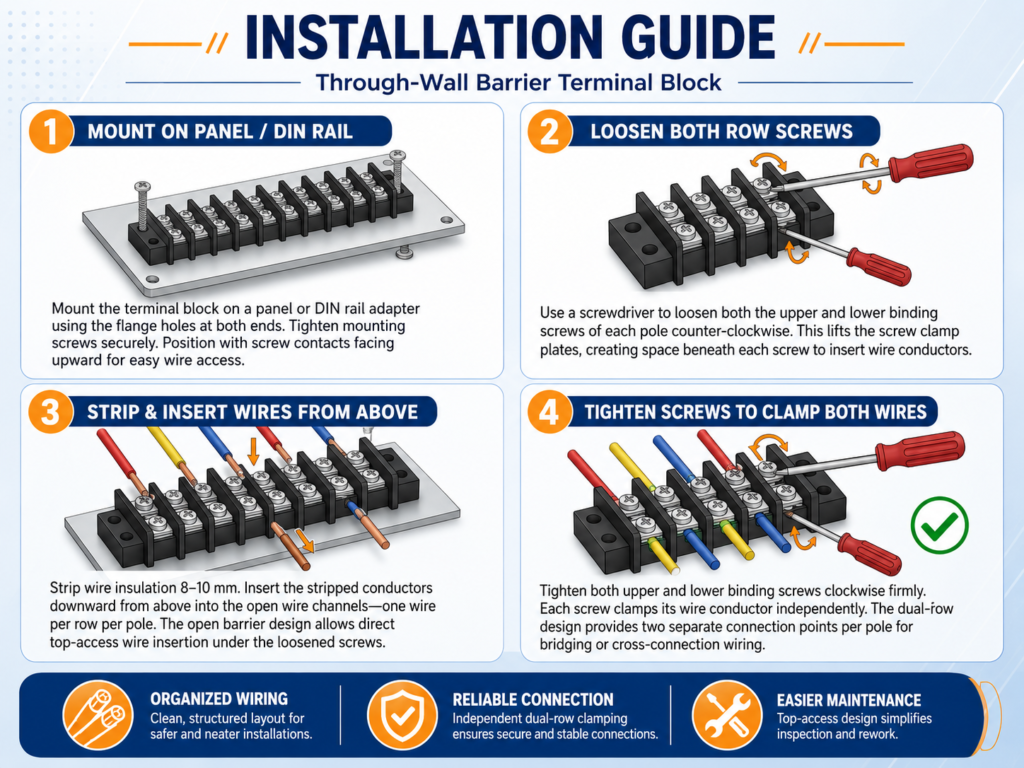
When Does a Replacement Really Require Panel Redesign?
Not every difference means the whole enclosure has to be redesigned. A redesign is usually necessary only when the replacement changes a critical interface.
Typical red flags include:
- The required panel cutout is different
- The panel thickness is outside the terminal’s permitted mounting range
- The terminal collides with internal components or cable ducts
- The required conductor cannot be connected correctly
- The electrical rating or required compliance no longer matches the project
If none of these red flags apply, a compatible alternative may be possible without changing the panel. This is why dimensional comparison should happen before a new enclosure drawing is released.
Send the Right Information and Get a Faster Compatibility Check
The fastest way to receive a useful recommendation is to give the supplier enough information to evaluate the application instead of simply asking for a similar-looking product.
| Information to Send | Example | Why It Matters |
|---|---|---|
| Existing model or photo | Current product model / clear photo | Helps identify the original structure |
| Dimension drawing | Panel cutout and terminal dimensions | Confirms mechanical fit |
| Rated current / voltage | 60 A / 600 V | Checks electrical suitability |
| Wire size and type | 10 mm² stranded wire | Checks conductor compatibility |
| Panel thickness | 2 mm | Checks mounting range |
| Required quantity | Sample / 1,000 pcs | Helps plan sample or production supply |
If you are replacing another manufacturer’s product, the existing drawing is often more useful than a long written description. It allows the supplier to compare the critical interfaces directly.
Use This 5-Point Check Before You Approve a Replacement
| Check | Pass Condition | Red Flag |
|---|---|---|
| Panel fit | Cutout and thickness are compatible | New machining is required |
| Electrical rating | Meets the application current and voltage | Rating is below project requirement |
| Wire compatibility | Accepts the actual conductor size and type | Wire cannot be terminated correctly |
| Rear clearance | Enough room for the terminal and cable | Interference with DIN rail, duct or device |
| Spacing / layout | Fits the existing terminal arrangement | Pole spacing forces a layout change |
For production projects, it is also sensible to confirm the dimensional drawing and test a sample before switching to a large order. That gives engineering and purchasing teams a chance to catch installation issues before they reach the production line.
Frequently Asked Questions
Can I replace a through-wall barrier terminal block with a different brand?
Yes, if the alternative meets the required mechanical dimensions, electrical ratings, conductor range and project requirements. Brand similarity alone is not enough.
Is the same current rating enough to confirm an equivalent?
No. The panel cutout, panel thickness, voltage rating, wire range, terminal spacing and installation clearance also need to be checked.
What should I send if I do not know the exact terminal model?
Send clear photos, a panel or terminal drawing, the wire size, current, voltage, panel thickness and required quantity. These details are usually enough to begin a compatibility check.
Before You Redesign the Panel, Check for a Compatible Alternative
If your current terminal block is difficult to source, has a long lead time or no longer fits your purchasing plan, changing the enclosure should not be the first step.
A compatible through-wall barrier terminal block may allow you to keep the existing panel design – but only after the mechanical and electrical requirements have been compared carefully.
Need help matching an existing through-wall barrier terminal block?
Send your model or photo, drawing, rated current, rated voltage, wire size, panel thickness and quantity. We can cross-check the key requirements and recommend a suitable option for evaluation.