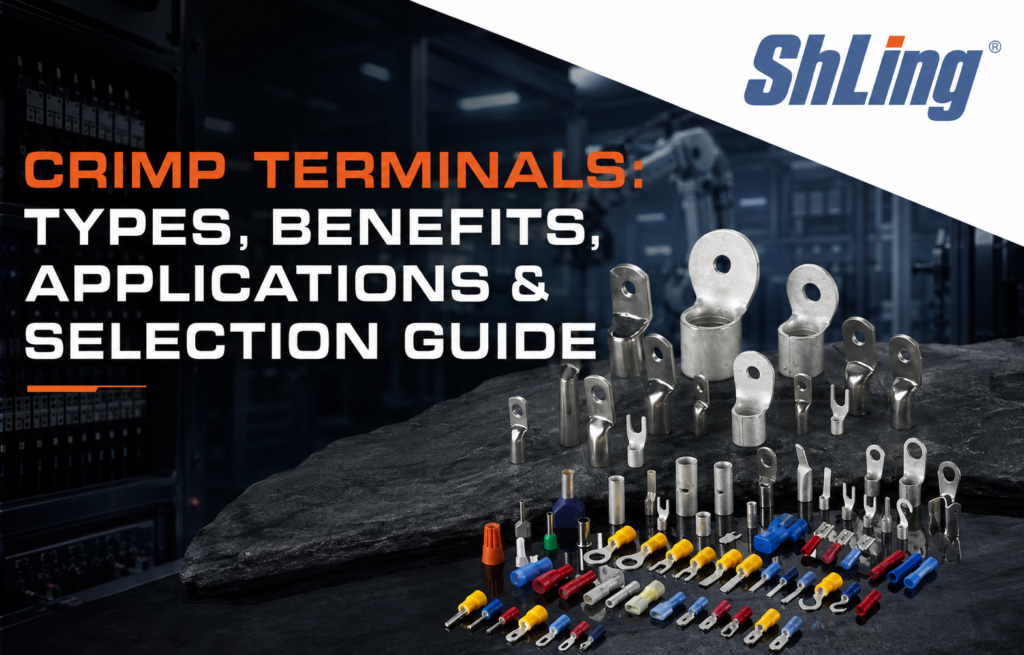
Crimp terminals are widely used in electrical wiring, control panels, industrial equipment, automotive wiring harnesses, home appliances, power supplies, and many other electrical systems.
Instead of soldering a wire directly to a connection point, a crimp terminal uses mechanical pressure to securely connect the conductor to a metal terminal. When the correct terminal, wire size, and crimping tool are used, a properly made crimp connection can provide reliable mechanical strength, stable electrical conductivity, and consistent performance over long-term use.
This guide explains what crimp terminals are, how they work, the most common types, their advantages, materials, applications, selection methods, crimping steps, common mistakes, and important factors buyers should consider when choosing a crimp terminal supplier.
What Is a Crimp Terminal?
A crimp terminal is an electrical connector that is mechanically attached to a wire using a crimping tool.
The basic installation process is simple:
- Strip the wire → Insert the conductor → Crimp the terminal → Inspect the connection
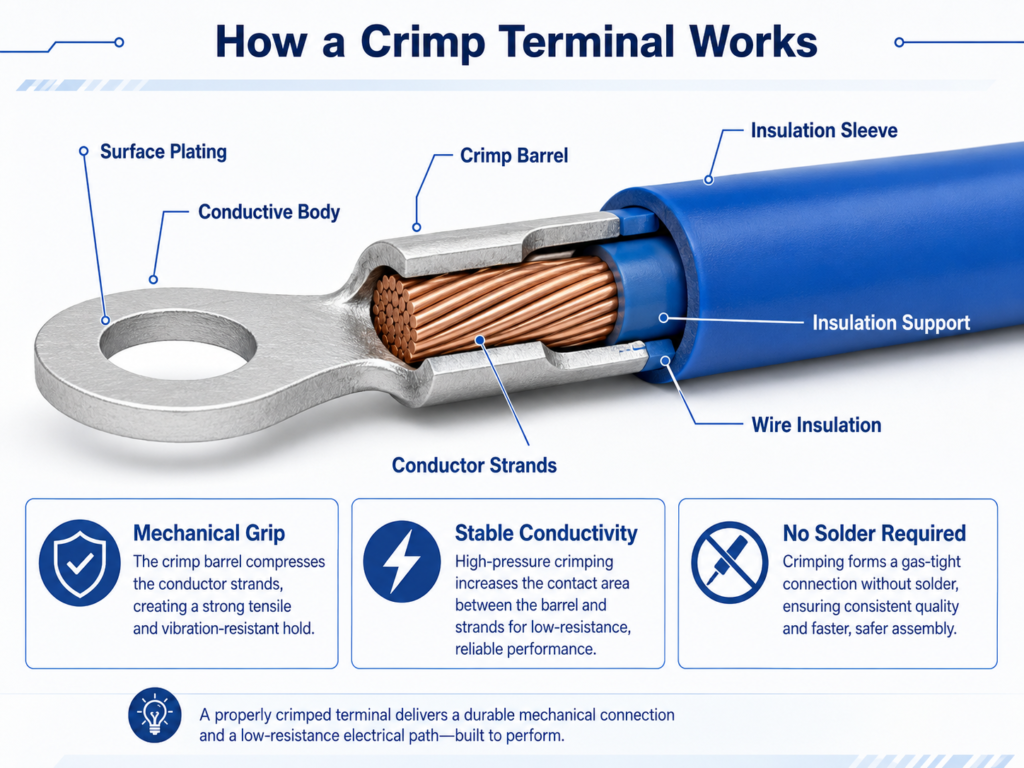
During crimping, the metal crimp barrel is compressed around the conductor. The pressure causes the terminal barrel to deform and tightly grip the wire strands, creating both a mechanical and electrical connection.
Unlike soldered connections, crimp terminals normally do not require heating, solder, or flux. This makes them particularly suitable for large-scale wire harness production and industrial wiring applications where speed, repeatability, and consistency are important.
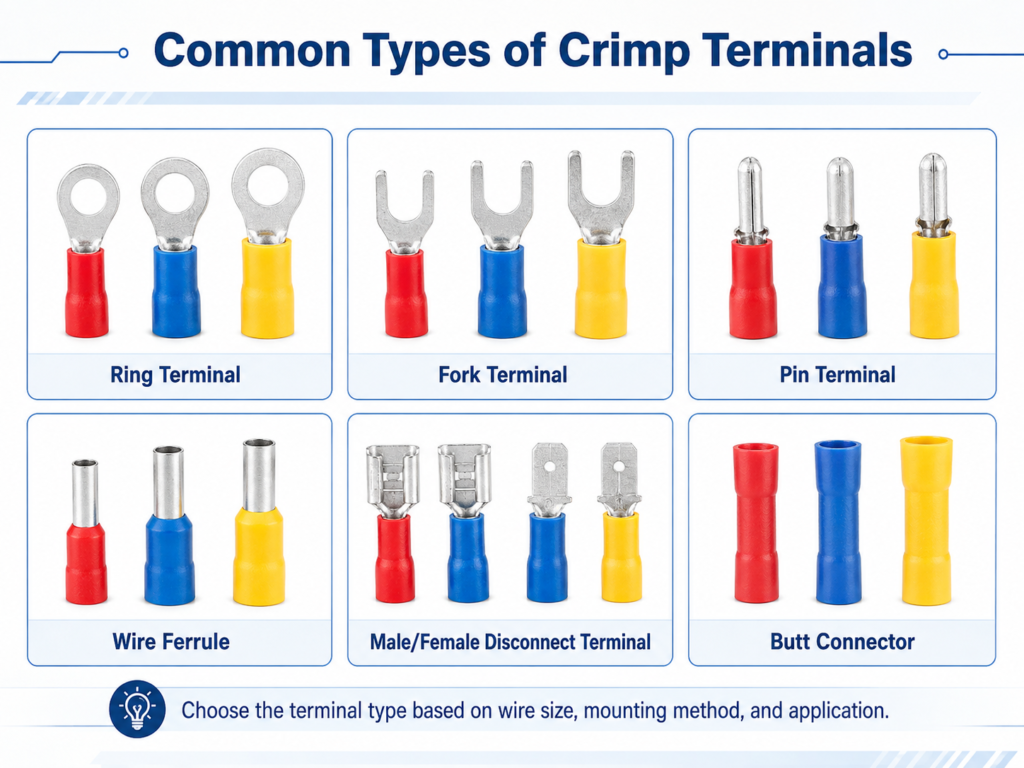
Common Types of Crimp Terminals
Crimp terminals are available in many different shapes and connection styles. The correct type depends on the wire size, mounting method, equipment structure, electrical requirements, and maintenance needs.
1.Ring Terminals
Ring terminals have a closed circular mounting hole. They are normally installed under screws, bolts, or studs. Because the ring completely surrounds the mounting screw, it provides excellent mechanical retention.
Common Applications
- Distribution panels
- Ground connections
- Power supplies
- Battery wiring
- Industrial equipment
- Automotive electrical systems
2.Fork Terminals
Fork terminals, also known as spade terminals, have an open U-shaped connection end. Unlike ring terminals, the screw does not always need to be completely removed during installation.
Advantages
- Faster installation
- Convenient maintenance
- Easy wire replacement
- Suitable for screw-type connection points
Fork terminals are commonly used in control cabinets, terminal strips, relays, switches, and electrical equipment.
3.Pin Terminals
Pin terminals convert stranded wire ends into a solid pin-shaped connection. They can make stranded wires easier to insert into certain terminal blocks and electrical devices.
Typical Applications
- Control panels
- Terminal blocks
- Power supplies
- Electrical cabinets
- Automation equipment
4.Wire Ferrules
Wire ferrules are commonly installed on the ends of stranded wires before the wires are inserted into terminal blocks. The ferrule keeps individual wire strands together and helps create a clean and organized wire termination. Ferrules are especially common in industrial control cabinets and DIN rail terminal block systems.
5.Blade Terminals
Blade terminals feature a flat conductive connection section. They are commonly found in electrical equipment, automotive systems, appliances, and quick-disconnect connections.
6.Male and Female Disconnect Terminals
Male and female disconnect terminals create detachable electrical connections. The male terminal inserts into the female terminal, allowing the circuit to be disconnected without cutting the wire.
Typical Applications
- Home appliances
- Automotive wiring
- Electrical equipment
- Lighting systems
- Control systems
7.Butt Connectors
Butt connectors are used to join two wires end-to-end. The wires are inserted from opposite sides and then crimped into the connector. They are widely used for cable extension, repair, and wiring harness connections.
Crimp Terminal Structure
A typical insulated crimp terminal may contain several important sections.
Conductive Body
The conductive body provides the main electrical connection. Copper or copper alloys are commonly used because of their good electrical conductivity and mechanical properties.
Surface Plating
Many terminals use a plated surface, such as tin plating. Depending on the product design and application, plating can help improve resistance to oxidation and corrosion while maintaining stable electrical contact.
Crimp Barrel
The crimp barrel is the section that is compressed around the wire conductor. Its dimensions must match the intended conductor size.
Insulation Sleeve
Pre-insulated terminals normally include a plastic insulation sleeve. Common materials may include:
- PVC
- Nylon
- PA-based engineering plastics
- Other electrical insulation materials
Material selection may depend on operating temperature, mechanical requirements, flame resistance, and environmental conditions.
Main Advantages of Crimp Terminals
1.Fast Installation
Crimp terminals normally require only a few installation steps. There is no need to heat the conductor or wait for solder to cool. For wire harness manufacturers and electrical equipment factories, this can significantly improve assembly efficiency.
2.Suitable for Mass Production
Crimping can be performed using:
- Hand crimping tools
- Ratchet crimping tools
- Pneumatic crimping machines
- Semi-automatic equipment
- Fully automatic wire processing machines
This makes crimp terminals suitable for both small-volume maintenance work and large-scale manufacturing.
3.Reliable Mechanical Connection
When the correct terminal and tool are used, the crimp barrel tightly grips the conductor. A good crimp connection helps reduce the risk of conductor movement, loosening, or pull-out during normal operation.
4.Stable Electrical Performance
A properly made crimp connection creates close contact between the conductor and terminal. This helps maintain low and stable contact resistance. Poor crimping, however, may increase resistance and cause abnormal heating. For this reason, crimp quality is an important part of electrical connection reliability.
5.Standardized Wiring
Crimp terminals make wiring more organized and repeatable. Manufacturers can define specific terminal types for specific wire sizes, helping improve consistency across production batches. This is particularly useful for:
- Control cabinet manufacturers
- Wire harness factories
- Electrical equipment manufacturers
- Appliance manufacturers
- Automotive component suppliers
- Automation system manufacturers
6.Wide Range of Sizes
Crimp terminals are available for many conductor sizes, stud sizes, connection methods, and installation environments. This gives designers and buyers significant flexibility during electrical system design.
Crimp Terminal Wire Size Selection
This section answers the first question: which terminal size fits which wire? The terminal barrel must match the conductor cross-sectional area — never select a terminal by appearance alone. Common conductor sizes run from 0.5 mm² upward (0.5, 0.75, 1.0, 1.5, 2.5, 4, 6 mm²). A simplified reference table is shown below.
| Wire Size | Approx. AWG Range | Common Terminal Category | Typical Application |
|---|---|---|---|
| 0.5–1.0 mm² | 20–18 AWG | Small insulated terminal | Signal wiring |
| 0.5–1.5 mm² | 22–16 AWG | Small crimp terminal | Control circuits |
| 1.5–2.5 mm² | 16–14 AWG | Medium crimp terminal | Control panels / appliances |
| 4–6 mm² | 12–10 AWG | Larger crimp terminal | Power wiring |
| 10 mm² and above | Application dependent | Heavy-duty terminal | High-current equipment |
How to Choose the Right Crimp Terminal
Wire-to-terminal matching is covered in the previous section. Beyond conductor size, the following factors decide whether a terminal is right for the job.
1.Check the Stud or Screw Size
For ring and fork terminals, confirm the mounting hole size. Common screw and stud sizes may include: M3, M4, M5, M6, M8, M10. The terminal opening should match the actual installation point.
2.Consider Current Requirements
Current-carrying capability depends on several factors, including:
- Wire size
- Terminal material
- Contact area
- Connection quality
- Ambient temperature
- Equipment design
For higher-current applications, larger conductors and appropriately rated terminals are required.
3.Check the Installation Environment
Consider whether the terminal will operate in:
- High temperature
- Humidity
- Vibration
- Corrosive environments
- Industrial environments
- Outdoor equipment
These conditions may affect the required material, plating, insulation, and connector structure.
4.Select the Correct Insulation Type
Insulated terminals can use different insulating materials. For applications requiring higher heat resistance, mechanical strength, or flame-retardant performance, the insulation material should be selected accordingly.
5.Use the Correct Crimping Tool
A good terminal can still perform poorly if it is crimped with the wrong tool. The crimping tool should match:
- Terminal type
- Terminal size
- Wire size
- Crimp profile
The correct die geometry and compression force are essential for repeatable connections.
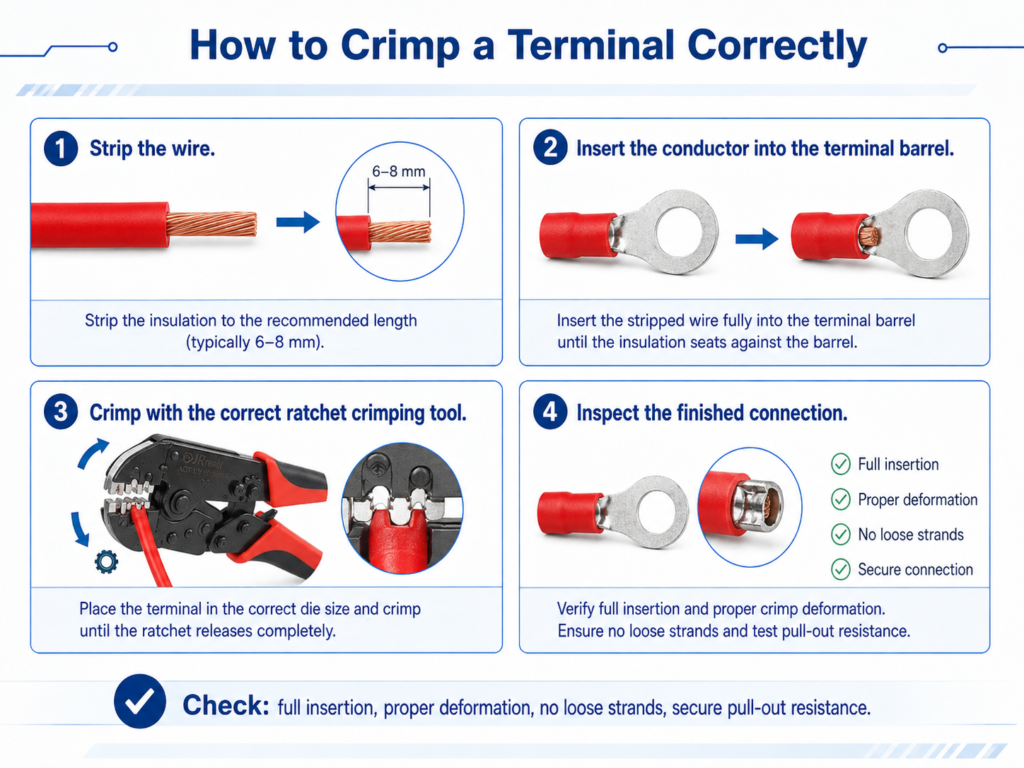
How to Crimp a Terminal Correctly
Step 1: Select the Correct Terminal
Confirm the terminal is matched to the wire before starting (see Wire Size Selection above).
Step 2: Strip the Wire
Remove the correct length of insulation. The stripped section should be long enough for the conductor to fully enter the crimp barrel. Avoid damaging or cutting wire strands during stripping.
Step 3: Insert the Conductor
Insert the conductor completely into the terminal barrel. Make sure the wire strands remain together and do not fold backward.
Step 4: Position the Terminal in the Crimping Tool
Place the terminal in the correct crimping die. Ensure the crimp area is properly aligned before applying pressure.
Step 5: Complete the Crimp
Apply the required crimping force. For ratchet tools, complete the full crimping cycle before releasing the tool.
Step 6: Inspect the Connection
Check that:
- The wire is fully inserted
- The terminal is not excessively deformed
- No excessive bare copper is exposed
- The conductor cannot easily pull out
- The insulation is not seriously damaged
For controlled production environments, additional dimensional or mechanical inspection may also be required.
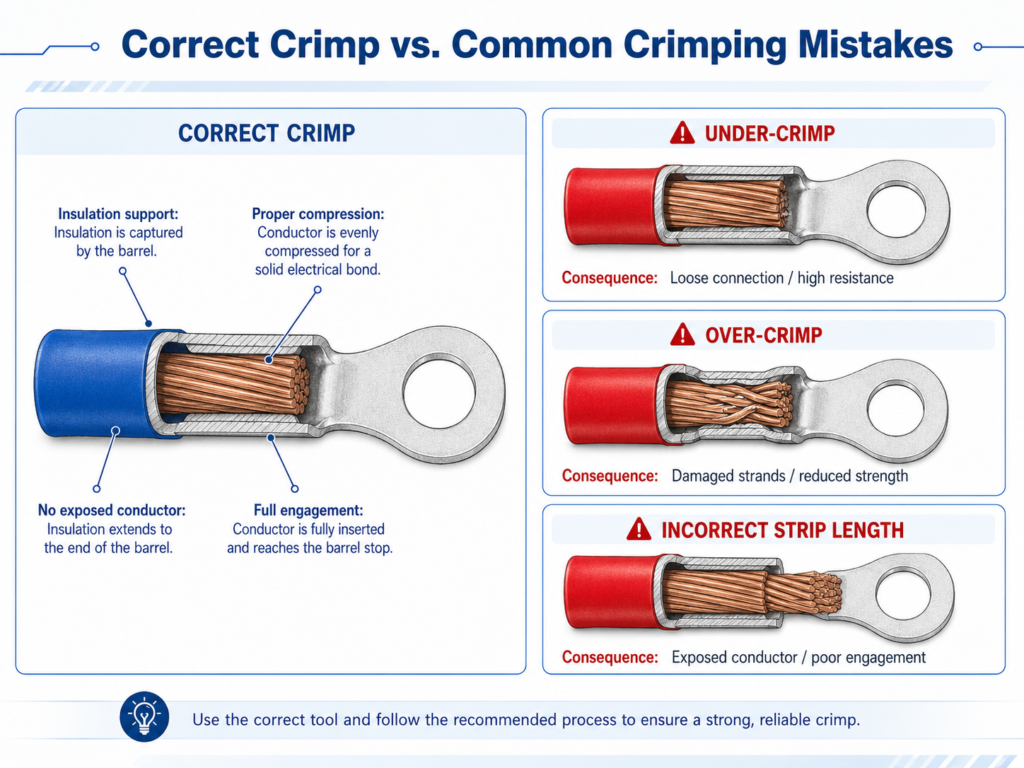
Correct Crimp vs. Incorrect Crimp
Under-Crimping
Under-crimping occurs when insufficient pressure is applied. Possible results include:
- Loose connection
- High contact resistance
- Wire pull-out
- Abnormal heating
- Unstable electrical performance
Over-Crimping
Over-crimping occurs when excessive compression is applied. Possible problems include:
- Damaged conductor strands
- Terminal deformation
- Reduced mechanical strength
- Damage to insulation
- Premature connection failure
Wrong Wire Size
If the conductor is too small for the terminal barrel, the terminal may not grip the conductor correctly. If the conductor is too large, it may not fit properly inside the terminal.
Incorrect Strip Length
Too much exposed conductor may reduce insulation safety. Too little stripped conductor may prevent full conductor engagement inside the crimp barrel.
Using Pliers Instead of a Crimping Tool
General-purpose pliers cannot normally create the controlled crimp geometry required for reliable electrical connections. For professional electrical work, a dedicated crimping tool should be used.
How Manufacturers Check Crimp Quality
For professional production, visual inspection alone may not be sufficient. Depending on the product and application, manufacturers may use several methods to evaluate connection quality.
Pull-Force Testing
A pull test measures how much force is required to separate the wire from the crimped terminal. This helps evaluate the mechanical strength of the crimp.
Crimp Height Inspection
Crimp height can be measured to check whether the terminal has been compressed to the required dimension. Incorrect crimp height may indicate under-crimping or over-crimping.
Cross-Section Analysis
In more demanding production environments, a crimped connection may be cut and examined under magnification. This allows engineers to inspect conductor compression, strand distribution, voids, and terminal deformation.
Contact Resistance Testing
Electrical resistance measurements can help evaluate whether the connection provides stable conductivity.
Temperature-Rise Testing
For higher-current applications, temperature-rise testing can help determine whether the terminal remains within acceptable thermal limits under load.
Applications of Crimp Terminals
Industrial Control Cabinets
Crimp terminals are widely used for wiring:
- Terminal blocks
- Circuit breakers
- Contactors
- Relays
- PLC modules
- Power supplies
- Control components
They help create organized and maintainable electrical wiring systems.
Automation Equipment
Automated machinery contains large numbers of power, control, and signal wires. Crimp terminals help standardize these connections and simplify assembly.
Automotive Wiring Harnesses
Crimp connections are widely used in vehicle electrical systems. Typical applications include:
- Sensors
- Lighting
- Control modules
- Power distribution
- Motors
- Accessories
Automotive applications may require additional consideration of vibration, temperature, moisture, and long-term durability.
Home Appliances
Crimp terminals are commonly found inside:
- Air conditioners
- Washing machines
- Refrigerators
- Kitchen appliances
- Power equipment
- Heating equipment
Lighting Equipment
LED lighting systems, drivers, power supplies, and lighting control equipment often use crimp terminals for internal wiring.
Renewable Energy and Power Equipment
Crimp terminals can also be found in:
- Solar equipment
- Energy storage systems
- Inverters
- Charging equipment
- Power distribution devices
Larger conductor sizes and higher-current terminals may be required for these applications.
Crimp Terminals vs. Soldered Connections
Both crimping and soldering can be effective electrical connection methods when properly designed and manufactured.
Crimp terminals are often preferred when:
- Fast assembly is important
- Large production quantities are involved
- Standardized wiring is required
- Mechanical termination is preferred
- Maintenance or replacement is expected
Soldering may be more appropriate for:
- PCB assembly
- Electronic components
- Certain low-current circuits
- Specialized electrical designs
There is no universal rule that one method is always better than the other. The correct choice depends on the electrical, mechanical, environmental, and manufacturing requirements of the application.
Crimp Terminals vs. Screw Connections
Crimp terminals and screw connections are also commonly used together. For example, a wire may first be fitted with a ring, fork, pin, or ferrule terminal and then connected to a screw-type terminal block.
Screw connections offer flexibility during installation and maintenance, while crimp terminals can provide a controlled termination at the end of stranded conductors. The most suitable solution depends on the equipment design.
What Should Buyers Check When Purchasing Crimp Terminals?
For industrial buyers, price should not be the only consideration. Several technical factors should also be reviewed.
Terminal Material
Confirm the conductive material used in the terminal.
Surface Treatment
Check whether the terminal uses tin plating or another appropriate surface treatment.
Wire Range
Verify the manufacturer’s specified conductor cross-section or AWG range.
Dimensions
For ring and fork terminals, confirm:
- Stud size
- Width
- Length
- Barrel dimensions
Insulation Material
Check whether the insulation material is suitable for the required temperature and environment.
Product Consistency
For large-volume orders, dimensional consistency and crimping repeatability are especially important.
Testing Capability
A professional supplier should be able to understand and control key quality factors such as:
- Material
- Dimensions
- Crimp performance
- Mechanical strength
- Electrical performance
Customization Capability
For OEM projects, buyers may also need:
- Special dimensions
- Custom packaging
- Private labeling
- Different colors
- Customized terminal combinations
- Technical drawings
- Samples before mass production
Frequently Asked Questions
Are crimp terminals reusable?
In most cases, a terminal that has already been crimped onto a conductor should not simply be removed and re-crimped onto another wire. Once crimped, the metal barrel has already been permanently deformed. If the terminal is damaged or the connection needs to be remade, replacing it with a new terminal is normally the safer approach.
Can crimp terminals be used with stranded wire?
Yes. Many crimp terminals are specifically designed for stranded copper conductors. However, the terminal must match the conductor size and type.
Can crimp terminals be used with solid wire?
Some terminal products may be designed for specific solid conductors, but many common crimp terminals are primarily intended for stranded wire. Always check the manufacturer’s specifications.
Why does a crimp terminal become hot?
Possible causes include:
- Incorrect wire size
- Poor crimp quality
- Loose electrical connection
- Excessive current
- Oxidation or contamination
- Inadequate contact area
Abnormal heating should be investigated because it can indicate excessive electrical resistance.
Should I solder a crimped terminal?
Normally, a crimp connection should be designed to achieve its required performance through the crimp itself. Adding solder may change the mechanical behavior of the wire near the termination. If soldering is required, it should follow the connector manufacturer’s recommended process.
What is the difference between a ferrule and a crimp terminal?
A ferrule is a specific type of crimped wire-end termination commonly used to prepare stranded conductors for terminal blocks. “Crimp terminal” is a broader category that includes ferrules, ring terminals, fork terminals, pin terminals, disconnect terminals, butt connectors, and other designs.
Conclusion
Crimp terminals are an important part of modern electrical connection systems. They provide a fast, standardized, and reliable method for terminating electrical wires when the correct terminal, conductor, and crimping process are used.
The most important factors when selecting a crimp terminal include:
Wire size, terminal type, material, stud size, electrical requirements, insulation, operating environment, and crimping method.
For manufacturers and industrial buyers, terminal quality should not be evaluated only by appearance or price. Material consistency, dimensional accuracy, crimp performance, mechanical strength, and electrical reliability are all important factors in long-term connection performance.
A properly selected and correctly crimped terminal can help improve wiring efficiency, connection consistency, and overall electrical system reliability.