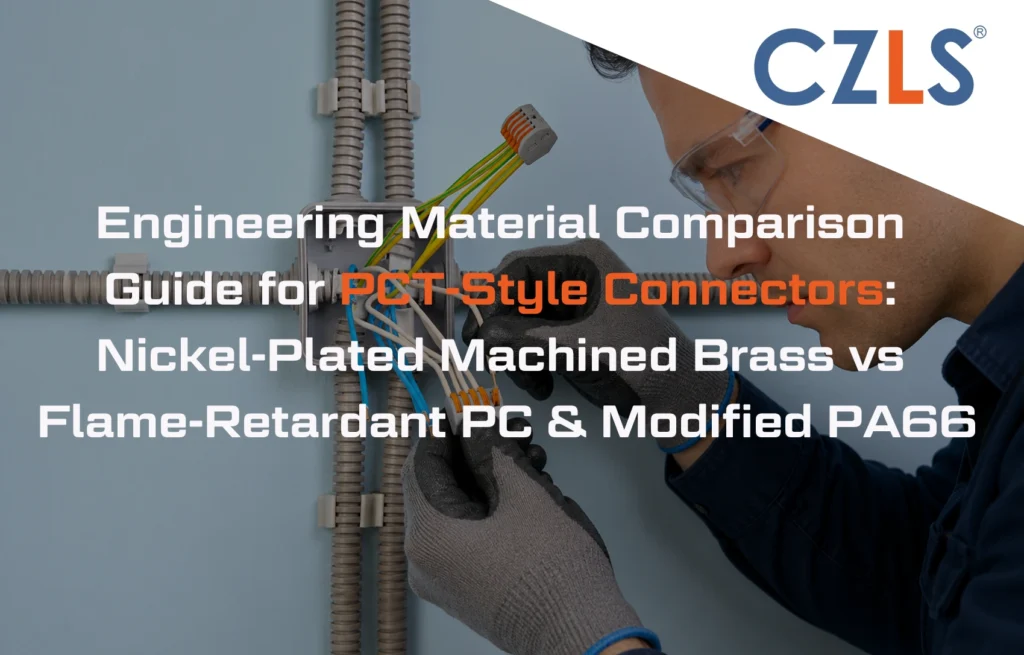
When selecting electrical wiring components, the Material of the Handle Connector plays a critical role in determining electrical reliability, thermal stability, flame resistance, and long-term durability. For electrical engineers, industrial equipment manufacturers, and wiring system designers, choosing the correct connector material directly impacts system safety and operational lifespan.
This guide provides a comprehensive comparison of the most common materials used in PCT-style handle connectors and terminal blocks, focusing on:
- Nickel-Plated Machined Brass
- Flame Retardant Polycarbonate (PC)
- Modified PA66 Nylon
We analyze their mechanical properties, corrosion resistance, thermal performance, and flame-retardant capabilities across various industrial electrical environments.
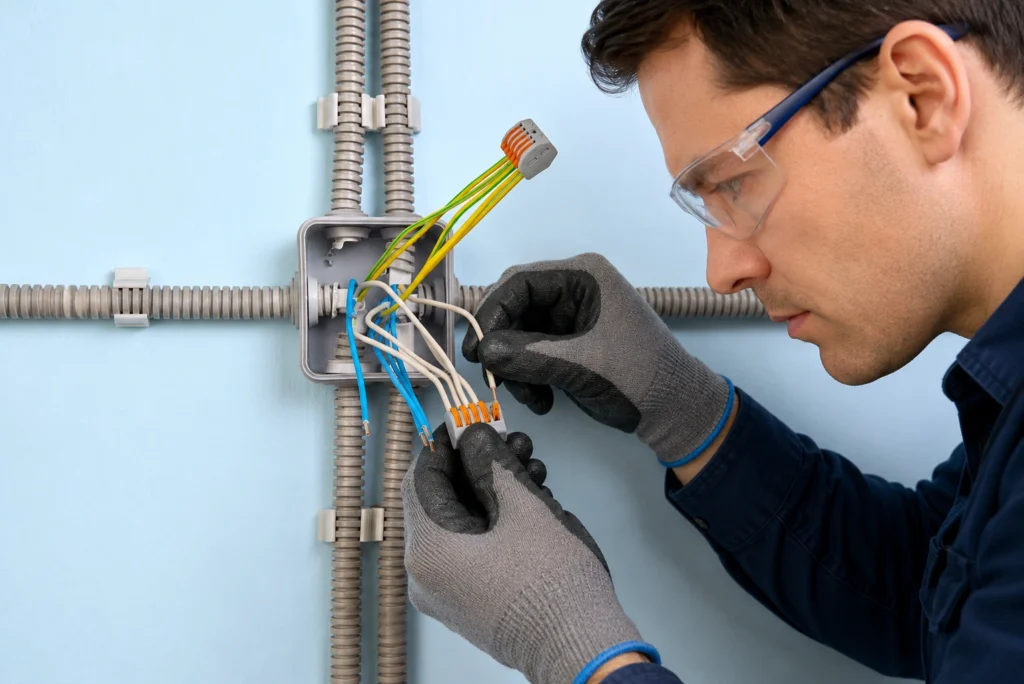
What Is the Material of the Handle Connector?
A PCT-style handle connector is typically composed of two major components:
- Conductive Metal Parts — responsible for current carrying capacity and contact stability
- Insulating Housing Materials — responsible for electrical insulation, flame resistance, and environmental durability
The combination of these materials determines the connector’s overall engineering performance.
Nickel-Plated Machined Brass in Handle Connectors
High Conductivity and Mechanical Strength
Nickel-plated machined brass is widely used in industrial terminal blocks and high-precision RF connectors due to its excellent conductivity and dimensional stability.
Key Advantages
- High electrical conductivity
- Excellent machining precision
- Strong vibration resistance
- Stable contact resistance
- Long insertion and extraction lifespan
The nickel coating significantly improves corrosion resistance, making the material suitable for humid and outdoor electrical environments.
Corrosion Resistance Performance
In industrial applications, nickel plating helps protect brass against:
- Oxidation
- Salt spray corrosion
- Moisture exposure
- Industrial pollutants
This makes nickel-plated brass ideal for:
- Outdoor electrical cabinets
- Solar power systems
- Coastal distribution equipment
- High-humidity industrial areas
Compared with standard copper components, nickel-plated brass provides more stable long-term electrical performance.
Flame Retardant Polycarbonate (PC) Material
Stable and Cost-Effective Connector Housing Material
Flame retardant polycarbonate is commonly used in medium-duty electrical handle connectors because of its dimensional stability and manufacturing efficiency.
Main Features
- Good insulation performance
- High dimensional consistency
- Smooth surface appearance
- Strong resistance to oils and cleaners
- Cost-effective manufacturing
PC materials can achieve UL94 V-0 flame retardant ratings, making them suitable for standard indoor electrical applications.
Thermal Performance of PC
Polycarbonate performs well in medium-temperature environments, but under continuous high-temperature loads, its long-term thermal resistance is generally lower than modified PA66 nylon.
Therefore, PC is more suitable for:
- Indoor control systems
- Standard wiring terminals
- Commercial electrical equipment
- Low-to-medium mechanical stress applications
Modified PA66 Nylon for Industrial Handle Connectors
The Mainstream Industrial Insulation Material
Modified PA66 nylon is one of the most widely used insulating materials in industrial-grade handle connectors and terminal blocks.
Key Engineering Advantages
- Excellent heat resistance
- High mechanical strength
- Strong fatigue resistance
- Superior impact resistance
- Enhanced flame retardant capability
Typical long-term operating temperatures can reach 105°C to 120°C, depending on formulation and flame-retardant additives.
Performance in Harsh Environments
Compared with PC materials, PA66 offers better reliability in:
- High-temperature environments
- High vibration machinery
- Industrial automation systems
- Railway electrical systems
UV-resistant modified PA66 is also widely used in outdoor electrical installations and solar energy systems.
Thermal Stability Comparison
Why Thermal Stability Matters
In continuous current-carrying applications, heat buildup directly affects connector lifespan and electrical safety.
Material Comparison
| Material | Thermal Stability | Continuous Operating Temperature |
| Modified PA66 | Excellent | 105°C-120°C |
| Flame Retardant PC | Good | Moderate temperature environments |
| Nickel-Plated Brass | Excellent heat dissipation | Depends on insulation material |
Nickel-plated brass offers outstanding thermal conductivity, helping dissipate localized heat quickly.
Flame Retardant Performance Comparison
Industrial handle connectors typically require compliance with UL94 V-0 flame retardant standards.
PA66 Nylon
Modified PA66 is highly effective in flame-retardant systems and can self-extinguish rapidly during overheating or short-circuit conditions.
Flame Retardant PC
PC materials can also achieve UL94 V-0 ratings, although mechanical toughness under extreme thermal cycling may be lower than high-end PA66 formulations.
Brass Components
Brass itself is non-flammable, but it must be combined with flame-retardant insulating materials to meet complete connector safety requirements.
Mechanical Performance Comparison
Nickel-Plated Machined Brass
Best suited for:
- RF connectors
- High vibration environments
- Precision electrical equipment
- Long service-life applications
Modified PA66
Ideal for:
- Industrial automation
- Heavy-duty wiring systems
- Transportation equipment
- Dynamic mechanical environments
Polycarbonate (PC)
More suitable for:
- Standard indoor applications
- Lower mechanical stress environments
- Cost-sensitive electrical systems
Best Material of the Handle Connector for Different Applications
Indoor Control Cabinets
Recommended combination:
- Flame Retardant PC or PA66 housing
- Nickel-plated brass conductor
Humid Industrial Environments
Recommended combination:
- Nickel-plated brass
- High flame-retardant PA66
Outdoor Solar Installations
Recommended combination:
- UV-resistant modified PA66
- Nickel-plated brass
RF Communication Equipment
Recommended material:
- High-precision machined brass structure
High Vibration Machinery
Best solution:
- Modified PA66 + machined brass combination
Conclusion
Choosing the correct Material of the Handle Connector is essential for ensuring long-term electrical safety, reliability, and environmental durability.
From an engineering perspective:
- Nickel-plated machined brass offers outstanding conductivity, corrosion resistance, and mechanical precision
- Modified PA66 nylon provides the best balance of heat resistance, flame retardancy, and mechanical durability
- Flame retardant polycarbonate delivers excellent dimensional stability and cost efficiency for standard indoor electrical systems
For demanding industrial environments involving moisture, vibration, or outdoor exposure, the recommended solution is:
Nickel-Plated Brass + Modified PA66
This combination provides superior electrical reliability, longer service life, and enhanced safety performance for industrial handle connectors and terminal block systems.