Why This Question Matters
A lower price does not automatically mean poor quality, and a higher price does not guarantee reliability. Terminal block quality should be evaluated through material specifications, electrical ratings, test results, manufacturing consistency, and verifiable documentation. Price differences between products can reflect many factors: production scale, automation level, distribution channels, brand positioning, feature sets, certification scope, and material or design choices. None of these, alone, tells you whether a specific product will perform reliably in your application.
Terminal blocks are critical connection points. Incorrect selection, installation, or maintenance can contribute to loose connections, excessive temperature rise, insulation damage, and equipment downtime.
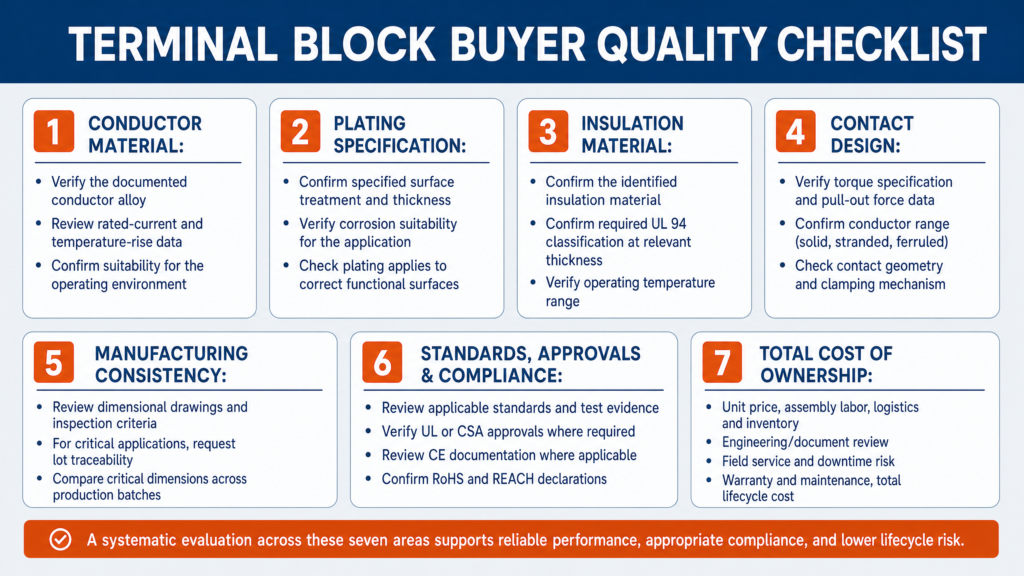
The seven factors below are the evaluation criteria that buyers and engineers should use to assess terminal block quality — regardless of where the product sits on the price spectrum.
Factor 1: Conductor Material and Specification
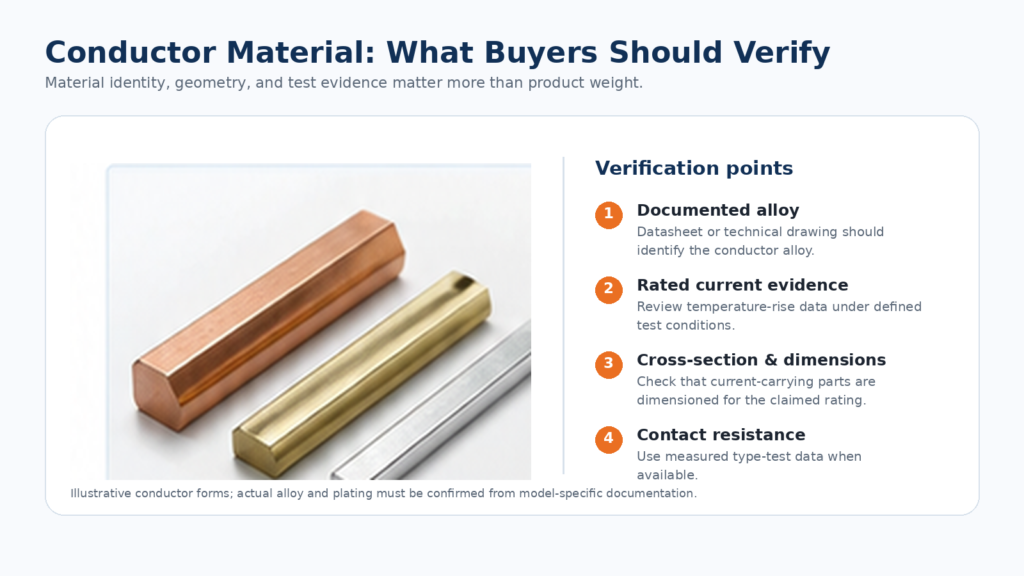
The conductor is the current-carrying heart of a terminal block. The conductor material strongly influences electrical conductivity, corrosion behavior, mechanical strength, and long-term contact stability. But you cannot judge conductor quality by price or by weight alone — you need documented specifications.
Terminal block current bars and contacts commonly use copper alloys selected to balance electrical conductivity, mechanical strength, formability, and resistance to stress relaxation. The exact alloy and conductivity should be confirmed from the manufacturer’s material specification. Different copper alloys serve different purposes: brass offers good conductivity and formability, bronze provides higher mechanical strength and elastic properties for spring contacts, and specialized alloys may be used for high-temperature or high-corrosion environments.
Material specification: The datasheet or technical drawing should identify the conductor alloy. If no material is specified, this is a warning sign.
Contact resistance: If available, review measured contact resistance values from type testing.
What should buyers verify?
Conductor cross-section and dimensions: Verify that the current-carrying component is dimensioned appropriately for the claimed rating.
Rated current and temperature-rise data: A terminal block’s rated current is not determined by material alone — it is validated through temperature-rise testing under defined conditions. Request the applicable datasheet, test summary, certification record, or product-specific evidence where required by the application.
Weight is not a reliable quality indicator. Two terminal blocks of the same nominal specification may differ in weight due to housing volume, pole count, screw size, mounting structure, partition thickness, conductor geometry, and accessory configuration. A heavier terminal block is not necessarily a better conductor, and a lighter one is not necessarily cutting corners.
Factor 2: Plating Specification and Corrosion Suitability
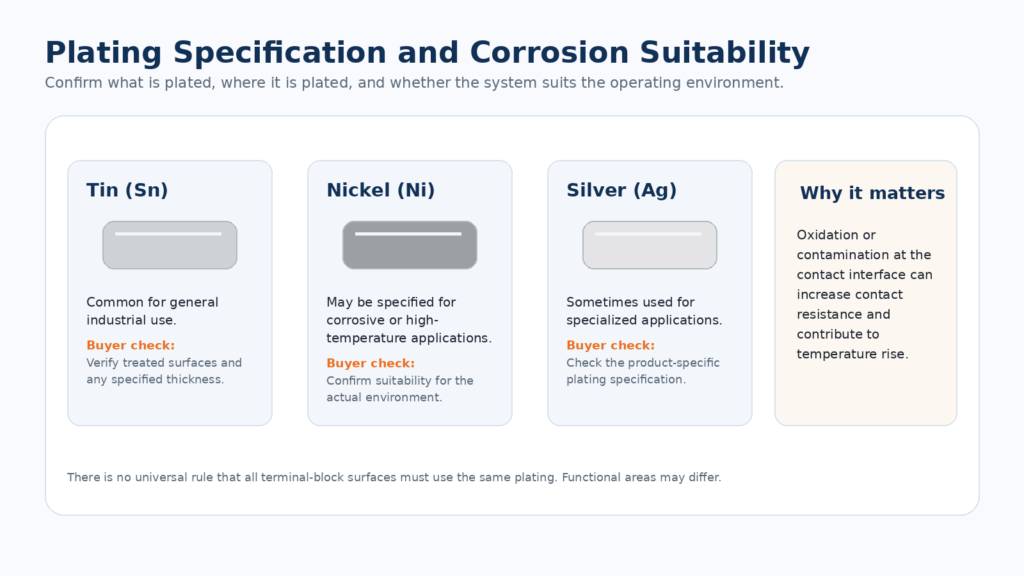
Plating protects the conductor surface from oxidation and helps maintain low contact resistance over the product’s service life. However, plating requirements vary by product structure, contact area, and functional surface — there is no universal rule that “all surfaces must be plated.”
Plating thickness: Where plating thickness is specified, it should be stated in measurable units. Some manufacturers provide thickness ranges for the base layer (e.g., nickel undercoat) and the top layer (e.g., tin).
What should buyers
Corrosion suitability: Confirm that the plating system is appropriate for the operating environment. Tin plating is common for general industrial use; nickel or other coatings may be specified for corrosive or high-temperature applications.
verify?
Specified surface treatment: The manufacturer’s documentation should identify the plating material (typically tin, sometimes silver or nickel for specialized applications) and the surfaces to which it is applied. Different functional areas — such as the wire-clamping region, the solder region for PCB terminals, or the mating contact zone — may have different plating specifications.
Oxidation or contamination at the contact interface can increase contact resistance and contribute to temperature rise. The actual effect depends on the contact material, plating system, contact pressure, and operating environment — not on a single factor in isolation.
For pluggable products, verify the rated mating-cycle count and contact-plating specification. For fixed screw terminal blocks, focus instead on conductor compatibility, tightening torque, pull-out performance, and long-term contact stability.
Factor 3: Insulation Material and Flammability Rating
The plastic housing of a terminal block is a safety-critical insulation barrier. The material grade strongly influences the housing’s flammability performance, insulation stability, and resistance to cracking or deformation.
PA66 (polyamide 6.6) is widely used in terminal block housings, but material selection varies by operating temperature, flammability requirement, chemical exposure, mechanical design, and soldering process. Other materials — such as PA46, PCT, or specialized engineering plastics — may be used for high-temperature applications. PA66 is common, but it should not be treated as the only valid indicator of quality.
Identified material: The datasheet should name the insulation material, not just say “plastic” or “nylon.”
Operating temperature range: Confirm the rated operating temperature of the complete terminal block, not just the generic material name. The same material can have different temperature limits depending on formulation and reinforcement.
Application-specific requirements: Depending on the application, the material formulation may also include UV stabilization or resistance to specific chemicals.
What should buyers verify?
Flammability rating: UL 94 V-0 is a vertical flammability classification with limits on individual and total afterflame time, afterglow, and flaming drips. It involves multiple evaluation criteria — not simply “self-extinguishes in 10 seconds with no drips.” The classification should be verified at the material thickness used in the actual housing, because a material’s UL 94 classification can vary with test thickness. (UL flammability testing)
These are not universal features — they are application-specific.
Factor 4: Contact Design and Clamping Performance
The mechanical design of the contact area — where the screw, spring, or push-in mechanism grips the wire — strongly influences whether the connection maintains stable contact pressure during thermal cycling, vibration, and normal service.What should buyers verify?
Pull-out force: The manufacturer should provide pull-out force data or reference a test standard.
Conductor range: Verify the minimum and maximum solid, stranded, and ferruled conductor sizes. Using a wire smaller than the terminal’s minimum means the clamp cannot exert enough pressure; using a wire larger means it physically will not fit.
What should buyers verify?
Torque specification: For screw-type terminals, the datasheet should specify the tightening torque and the permitted conductor range.
Contact geometry: Quality contacts feature properly manufactured geometry — the clamping mechanism applies pressure evenly across the wire cross-section, the current bar is dimensioned for the rated current, and screw threads (where used) are consistent and clean. In spring-cage designs, the spring element should be properly formed and heat-treated to maintain contact pressure over the product’s service life.
Contact components may be produced through stamping, forming, heat treatment, cold heading, or thread rolling. Buyers should focus on dimensional consistency, contact pressure, conductor retention, and compliance with the product specification.
Factor 5: Manufacturing Consistency and Lot Traceability
A single approved sample does not demonstrate long-term batch-to-batch consistency. What matters in production is consistency — that the parts delivered in the next batch perform the same as the ones in the first batch.
Lot traceability: For critical, regulated, or customer-specified applications, request lot-traceability information covering the production date, inspection status, and relevant material or process records.
Batch consistency: If you receive samples from different production lots, compare critical dimensions. Significant variation in pitch, pin straightness, or housing dimensions between batches indicates weak process control.
What should buyers
Dimensional drawings and inspection criteria: Reliable manufacturers define and control critical characteristics such as pitch, pin alignment, clamping dimensions, contact resistance, plating condition, and housing dimensions. The applicable tolerances and inspection methods depend on the product drawing, production process, and quality plan.
verify?
Sample inspection reports: For critical applications, request dimensional measurement reports, contact resistance sampling data, or plating thickness verification from the supplier.
Manufacturers may use various inspection tools — including statistical process control (SPC), in-die sensors, X-ray fluorescence (XRF) for plating thickness, or coulometric methods — but these are specific to each factory’s quality system. They are not universal requirements that every manufacturer must meet. The buyer’s concern is whether the delivered product meets specification, not which specific tool the factory uses to achieve it.
Factor 6: Standards, Third-Party Approvals, and Regulatory Compliance
Not all marks and standards serve the same purpose. Understanding the distinctions helps buyers make correct compliance decisions.
- Standards: IEC 60947-7-1 is a standard for terminal blocks used in low-voltage switchgear and controlgear assemblies. Products may be tested or evaluated according to this standard, but IEC 60947-7-1 is a standard — not a certification that a product “carries.” It applies to terminal blocks for copper conductors mounted on a fixed support, and may not automatically cover all PCB terminal blocks, connectors, or other terminal categories. IEC 61984 may be more directly relevant for pluggable connector interfaces, depending on the product design. (IEC 60947-7-1)
- Third-party approvals: UL 1059 (North American standard) and CSA C22.2 No. 158 (Canadian standard) are widely used for evaluating terminal blocks. When a product holds a UL or CSA approval, the approval is specific to a product model and can be verified in the issuing body’s online database. Whether a specific approval is required depends on the end-product certification, customer specification, or local authority having jurisdiction — some schemes are voluntary. (CSA C22.2 No. 158)
- Regulatory compliance: CE marking is generally a manufacturer’s declaration of conformity with applicable EU directives — not a third-party certification or safety approval by an EU body. CE marking applies only when the product falls within the scope of applicable EU harmonization legislation. For components such as terminal blocks, applicability should be assessed based on how the component is marketed and used in the final equipment. (CE marking guidance) RoHS and REACH are environmental and chemical substance regulations — not product safety certifications. They are compliance requirements that apply alongside, not instead of, safety standards. (RoHS Directive) (REACH Regulation)
What should buyers verify?
A supplier’s declaration should be supported by product-specific technical documentation and applicable test evidence.
Where third-party approval is required by the end-product certification, customer, or target market, verify the approval in the issuing body’s database.
Request an official certificate copy, file number, or database record that identifies the specific product model, and verify it through the issuing organization.
Confirm that the document matches the specific product model — not a different product from the same or a different manufacturer.
Factor 7: Total Cost of Ownership
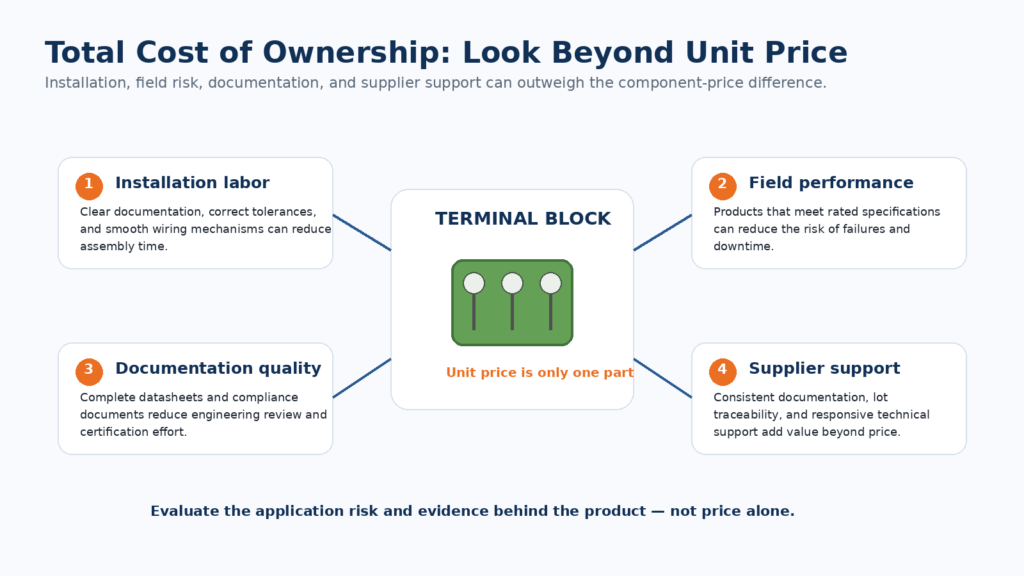
The unit price of a terminal block is a small fraction of its total cost of ownership. The real cost includes installation labor, field failure risk, warranty exposure, and potential recall costs.
Hypothetical example: If a premium terminal block costs 2.00 and a lower-priced alternative costs0.40, the difference across 200 positions in a panel is $320. That difference may be smaller than the cost of a field service call, warranty claim, or equipment downtime event, depending on the application. Actual prices, failure rates, service costs, and downtime losses vary by product and application — this example is illustrative only.
Field performance: Terminal blocks that meet their rated specifications under actual operating conditions reduce the risk of field failures. Request temperature-rise data, pull-out force data, and — for pluggable types — mating cycle data.
Documentation quality: Complete datasheets, material specifications, and compliance documents reduce engineering review time and simplify end-product certification.
What should buyers consider?
nstallation time: Terminal blocks with clear documentation, correct tolerances, and smooth wiring mechanisms reduce assembly time and labor cost.
Documentation quality: Complete datasheets, material specifications, and compliance documents reduce engineering review time and simplify end-product certification.
Summary: What to Verify and What to Watch For
| Factor | FactorWhat to Verify | Potential Warning Signs |
| Conductor material | Documented alloy, rated current and temperature-rise data | No material information or inconsistent samples |
| Plating | Specified surface treatment and corrosion suitability | No plating specification or visible inconsistency |
| Insulation | Identified material and verified flammability rating at product thickness | Generic material description without documentation |
| Contact design | Torque, pull-out force, and conductor-range data | Missing installation specifications |
| Consistency | Drawings, inspection criteria, and lot control | Major batch-to-batch dimensional variation |
| Compliance | Model-specific, verifiable documents (standards, approvals, declarations) | Documents that do not match the product model |
| Total cost of ownership | Installation time, documentation quality, expected maintenance, supplier support | Selection based only on unit price without evaluating application risk |
Frequently Asked Questions
Does a higher terminal block price always mean better quality?
No. Price reflects many factors — production scale, automation level, brand positioning, distribution channels, feature sets, and certification scope. A higher price does not automatically guarantee better material, performance, or certification. Evaluate quality through documented specifications, test results, and verifiable compliance documents, not price alone.
How can I verify the conductor material?
Request the material specification from the manufacturer’s datasheet or technical drawing. The specification should identify the alloy used. For critical applications, you can request a material test report or send a sample to an independent laboratory for composition analysis.
Is terminal block weight a reliable quality test?
No. Weight is affected by housing volume, pole count, screw size, mounting structure, partition thickness, conductor geometry, and accessory configuration. A heavier terminal block is not necessarily a better conductor, and a lighter one is not necessarily deficient. Use documented material specifications and test data instead.
How can I verify a UL or CSA approval?
Request the certification document with the specific product model number. For UL, verify the file number in UL’s Product iQ database. For CSA, verify through the CSA certification database. Confirm that the document matches the exact product model you are purchasing — not a different product from the same or a different manufacturer.
What test documents should a terminal block supplier provide?
Depending on the product and application: temperature-rise test data, dielectric strength test results, pull-out force data, short-circuit withstand data (for relevant standards), dimensional inspection reports, plating thickness verification, and material specifications. Not all tests apply to all product types — confirm which are relevant to your application.
Which terminal block specifications should I confirm before ordering?
Rated current and voltage, conductor range (solid, stranded, ferruled), pitch, pole count, mating direction (for pluggable types), tightening torque (for screw types), operating temperature range, flammability rating, applicable standards, required approvals for your target market, and PCB compatibility (pin dimensions, soldering process, mounting orientation).
Choosing Terminal Blocks from ShLing
ShLing provides terminal block options for different electrical, wiring, and installation requirements. Available datasheets, drawings, material information, test documents, and approvals vary by product series. When requesting a quotation or sample, please provide your current, voltage, conductor size, pitch, pole count, application, and target market so that the required specifications and available documentation can be confirmed.
References and Technical Notes
• IEC 60947-7-1 — Terminal blocks for copper conductors (standard, not a certification)
• IEC 61984 — Connectors with rated voltages above 50 V AC or 75 V DC
• UL 1059 — Terminal blocks (North American standard), verifiable via UL Product iQ
• CSA C22.2 No. 158 — Terminal blocks (Canadian standard)
• UL 94 — Tests for flammability of plastic materials• CE marking — Official guidance (European Commission)
• RoHS Directive (2011/65/EU) and REACH Regulation (EC 1907/2006)