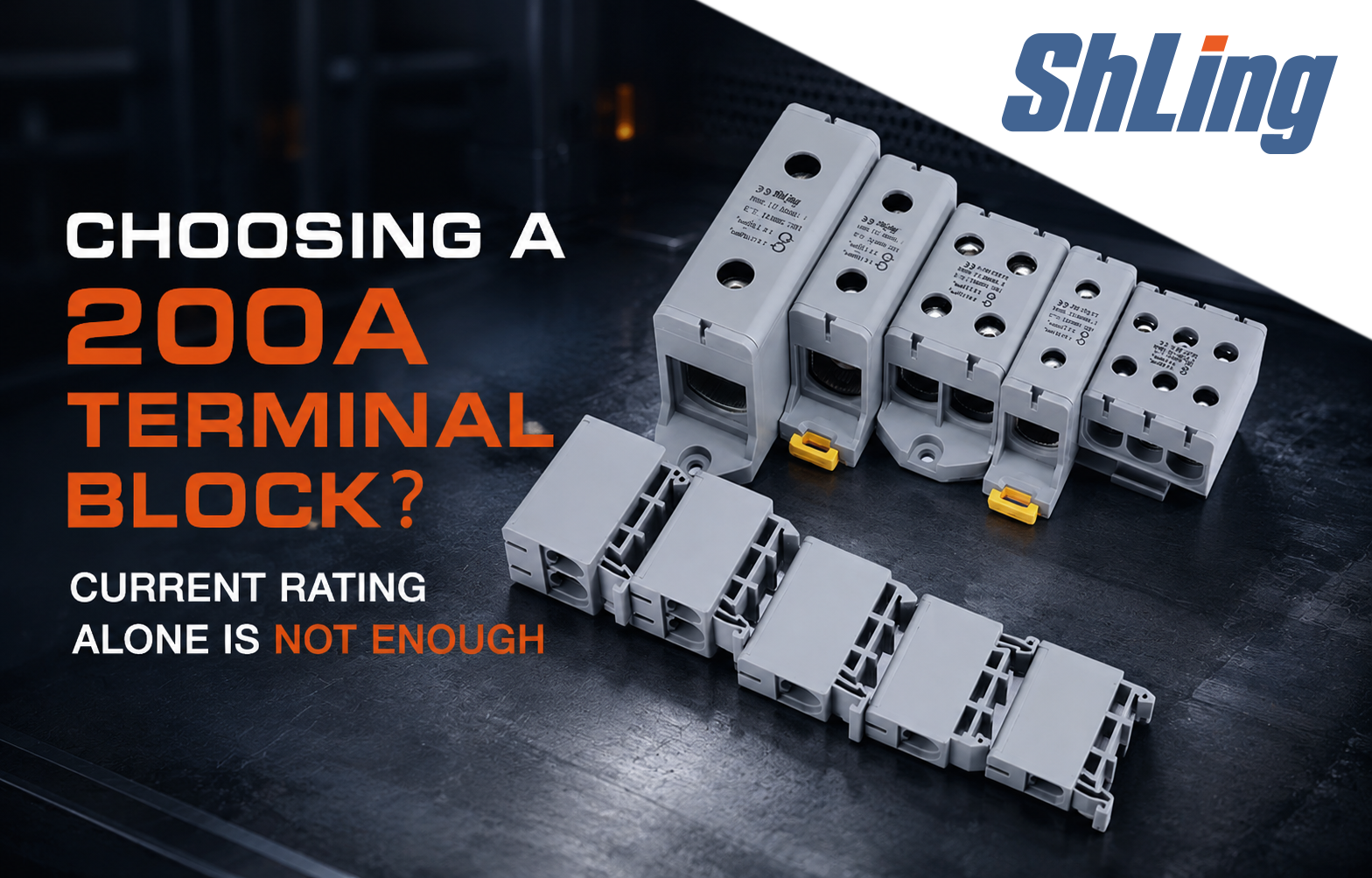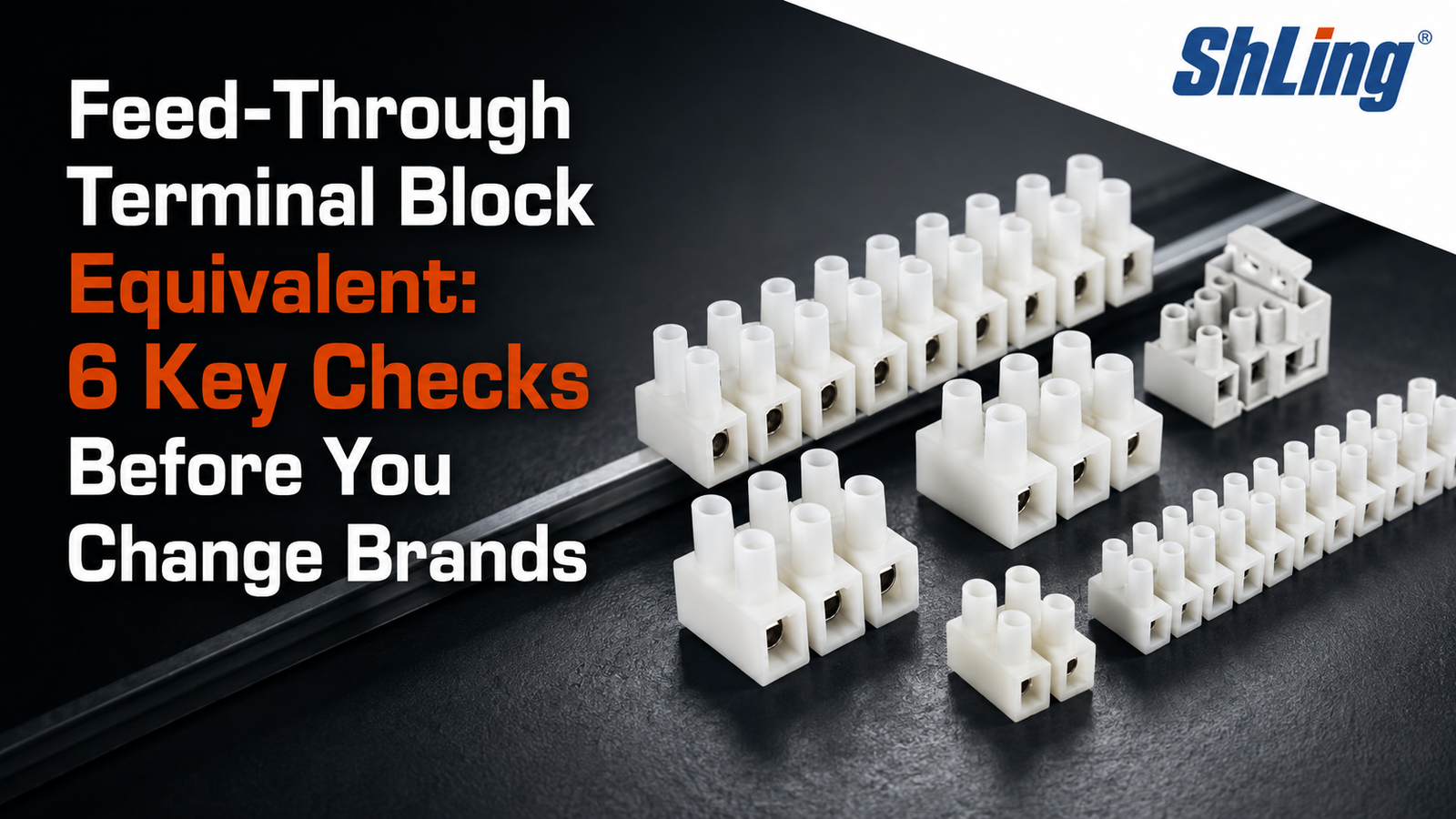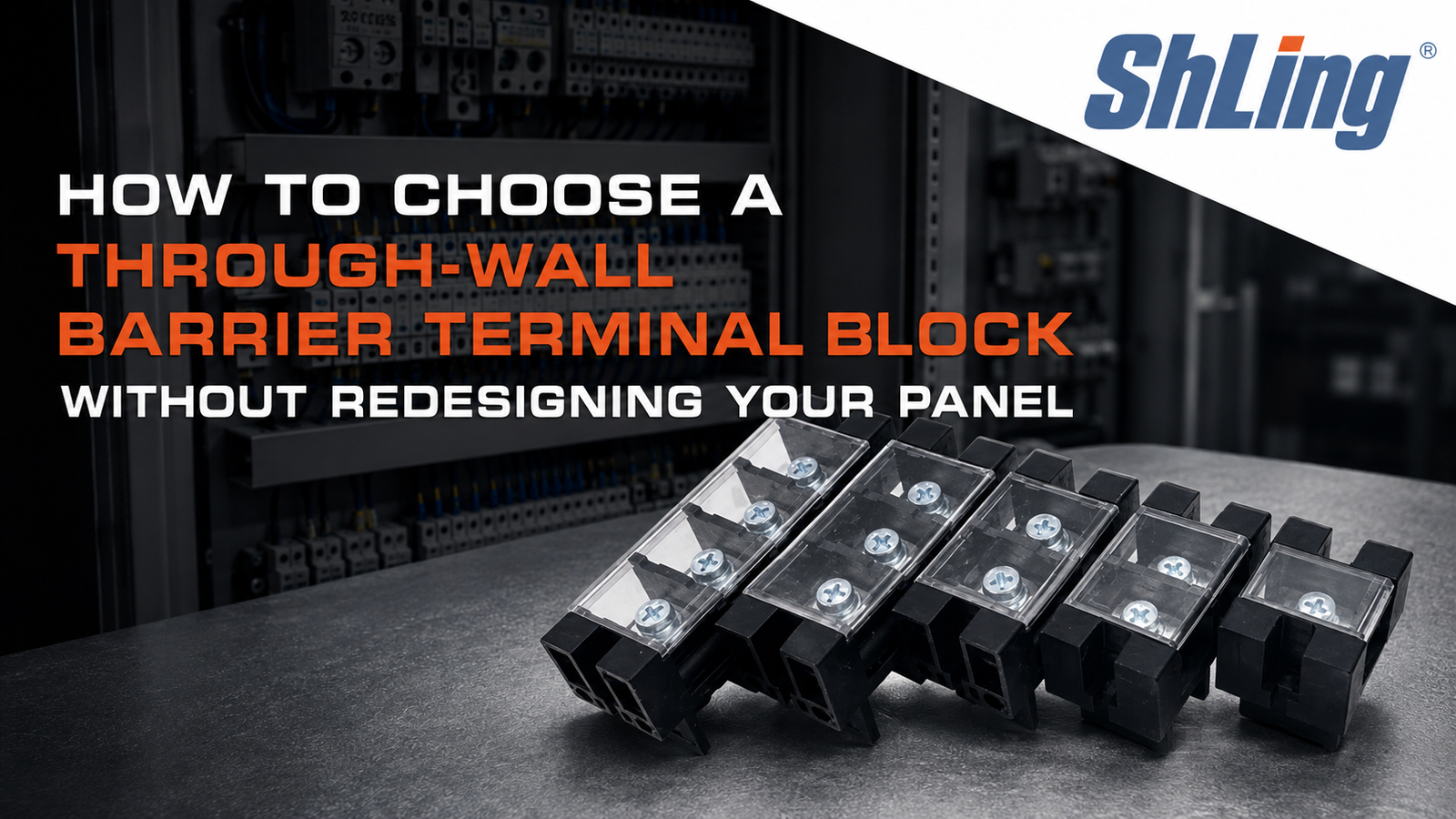
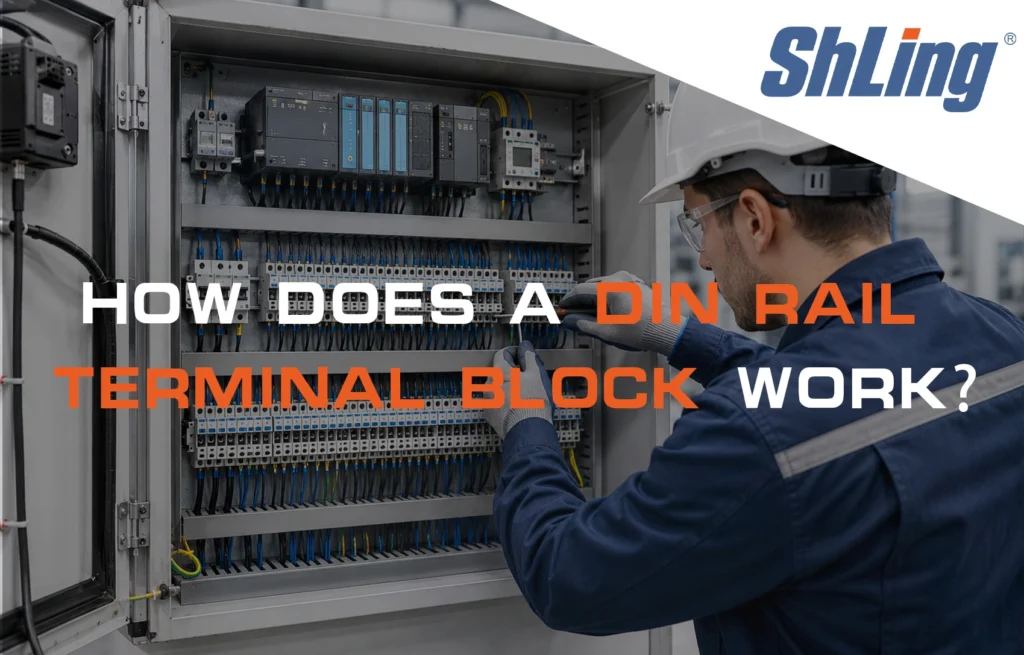
Open an industrial control cabinet and you will usually see orderly rows of compact plastic blocks mounted on a metal rail. They may look like passive wiring accessories, but they perform one of the panel’s most important jobs: creating secure, traceable, and serviceable connections between field wiring and control equipment. A DIN Rail Terminal Block turns loose conductors into an organized electrical system that technicians can install, test, expand, and repair with confidence.
So how does a DIN Rail Terminal Block work? The short answer is that it combines three elements: a standardized rail for mechanical support, a conductive metal path for current, and a clamping mechanism that holds each wire against that path. The real value, however, lies in what this simple arrangement makes possible. It improves connection reliability, reduces wiring errors, saves panel space, and makes future maintenance far easier. Understanding those benefits starts with the rail itself.
What Is a DIN Rail?
A DIN rail is a standardized metal mounting strip used inside electrical enclosures, control cabinets, and equipment racks. The most common version is the 35 mm top-hat rail. DIN refers to the German standards organization Deutsches Institut für Normung, whose standards helped establish a common mounting system for industrial components.
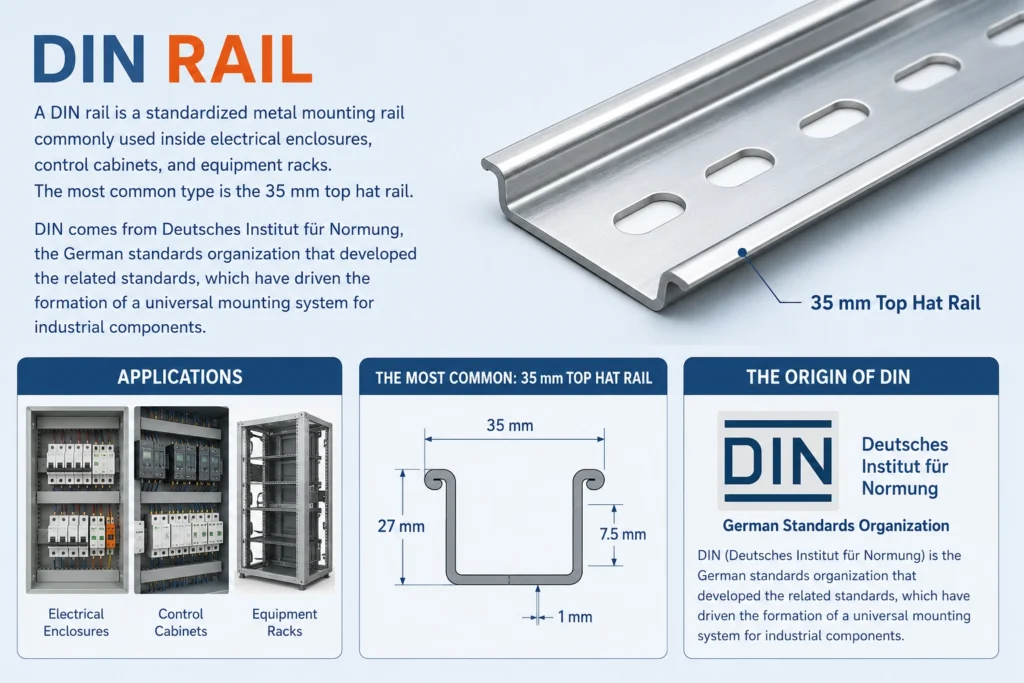
The rail is primarily a mechanical backbone. Relays, circuit breakers, power supplies, interface modules, and terminal blocks can all snap onto the same support without individual drilling or custom brackets. In normal feed-through circuits, the rail is not used as the current-carrying conductor. When it is properly bonded to protective earth, however, approved ground terminal blocks can connect directly to it. This distinction is important: the rail organizes the panel mechanically, while the terminal block controls the intended electrical path.
What Is a DIN Rail Terminal Block?
A DIN Rail Terminal Block is an insulated, rail-mounted connector that joins one or more conductors at a fixed and clearly identified point. Its housing is commonly made from flame-retardant polyamide. Inside the housing, a copper or copper-alloy current bar forms the electrical bridge between connection points, while a screw, spring, or blade mechanism presses each conductor firmly against that bar.
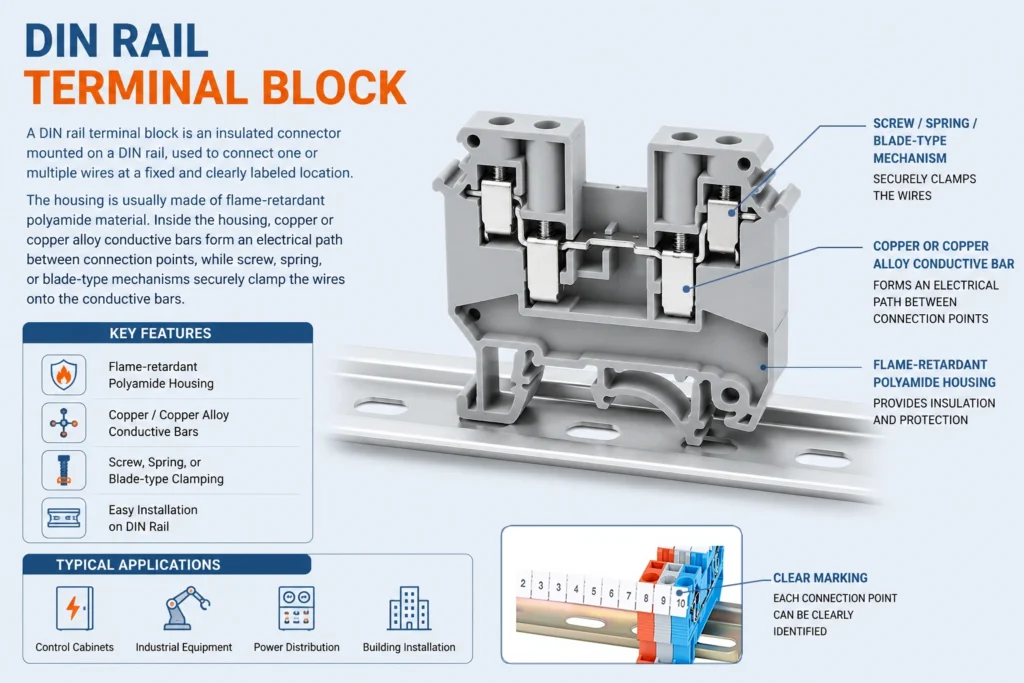
This compact assembly solves several problems at once. It creates a low-resistance electrical connection, mechanically retains the conductor, separates adjacent circuits with controlled insulation distances, and gives technicians a consistent place to label and test each wire. External cable strain relief may still be required, but the connection itself is protected from casual movement and accidental contact.
In a basic feed-through DIN Rail Terminal Block, one wire enters from one side and another wire enters from the opposite side. Both touch the same current bar, so current flows through the block from one conductor to the other. That is the essential operating principle. More advanced versions add extra levels, disconnect points, fuses, test sockets, or protective-earth contacts, but they all build on the same controlled path from wire to clamp, clamp to current bar, and current bar to the next wire.
How a DIN Rail Terminal Block Makes an Electrical Connection?
Every connection method has the same objective: maintain sufficient contact pressure to keep electrical resistance low, even when the panel experiences vibration, temperature changes, or years of service. The conductor must be stripped to the specified length, inserted fully, and held against the current bar without damaging the copper. The clamping technology determines how that pressure is created and maintained.
Screw-clamp terminals use a screw-driven pressure plate or clamping yoke. Tightening the screw presses the conductor onto the current bar and creates a strong, inspectable connection. They accept a wide range of conductor sizes and remain familiar to installers worldwide. Their performance depends on correct preparation and manufacturer-specified torque. Too little torque can produce a loose, high-resistance joint; too much can damage the conductor or terminal. Fine-stranded conductors are normally fitted with correctly sized ferrules before insertion.
Spring-cage terminals replace installation torque with a calibrated stainless-steel spring. A tool opens the spring, the conductor is inserted, and releasing the spring applies constant pressure. Push-in terminals use the same principle but allow solid or ferruled conductors to be inserted directly. These designs are fast to wire and automatically compensate for small dimensional changes caused by vibration or thermal cycling, which makes them attractive in high-density or high-throughput panel production.
Insulation displacement connections are designed for specific wire types and cut through the insulation to contact the conductor without a separate stripping step. Pluggable terminal systems divide the connection into a fixed header and a removable plug, allowing equipment to be exchanged without disturbing individual field wires. Each technology serves a different installation need, but the working logic of the DIN Rail Terminal Block remains consistent: create controlled pressure, preserve a stable metal-to-metal contact, and keep the circuit accessible for inspection.
How Multi-Level DIN Rail Terminal Blocks Save Panel Space?
Panel space has a direct cost. A longer rail may require a larger enclosure, more wiring duct, and longer conductor runs. Multi-level DIN rail terminal blocks address this by stacking two or more electrically independent connection tiers within nearly the same rail footprint as a single-level block.
A double-level block, for example, can terminate two separate circuits vertically instead of placing two blocks side by side. Triple-level versions can organize common control functions such as positive supply, signal, and return in one compact location. The circuits remain separated by the block’s internal insulation system, and any combination of voltages or functions must stay within the product’s ratings and applicable separation requirements. Used correctly, multi-level designs reduce cabinet size while keeping related wiring grouped and easier to trace.
Common Types of DIN Rail Terminal Blocks?
Feed-through blocks are the standard choice for joining conductors, but many circuits need more than a straight connection. Protective-earth terminal blocks bond the connected conductor to a properly grounded DIN rail through a metal mounting foot. Their green-and-yellow identification makes protective-earth points easy to recognize during installation and inspection.
Fuse terminal blocks place a replaceable fuse in series with the circuit, combining connection and overcurrent protection in one location. Disconnect and knife-disconnect blocks allow a circuit to be opened for testing or maintenance without removing wires. Some models include indicator lights, test points, or plug-in bridges, helping technicians isolate faults and distribute a common potential across several terminals.
Specialized versions support demanding signals and environments. Thermocouple terminal blocks use compatible conductive materials to avoid introducing unwanted measurement junctions. Sensor and actuator blocks can group power, signal, and return connections. High-current, miniature, and hazardous-location models extend the same basic concept to different conductor sizes, space constraints, and certification needs. Choosing the right type ensures that the terminal does more than fit the rail; it performs the exact electrical and maintenance function the circuit requires.
How to Choose the Right DIN Rail Terminal Block?
A reliable connection begins before the wire is inserted. The selected DIN Rail Terminal Block must be rated for the circuit voltage, expected current, conductor material, wire size, and conductor type. The connection technology should also match the work: screw clamps offer broad compatibility, spring and push-in designs speed repetitive wiring, and pluggable systems simplify equipment replacement. Environmental conditions such as vibration, temperature, contamination, and required approvals must be considered as part of the same decision.
Accessories matter as well. End plates protect exposed sides, end stops hold the terminal row in position, jumpers distribute common potentials, markers identify circuits, and test accessories improve commissioning. A block that appears inexpensive by itself can create extra labor if it is difficult to label, test, or bridge. The most persuasive reason to choose a complete terminal system is therefore not the purchase price of one connector, but the lower total effort required to build and maintain the panel throughout its service life.
How to Install and Wire a DIN Rail Terminal Block?
Electrical installation should be performed by qualified personnel using an approved procedure. Before work begins, the circuit must be de-energized, locked out where required, and verified as safe. The terminal block is then snapped onto the correct rail, arranged with the required separators and end plates, and secured as a row with end stops.
Each conductor is stripped to the length specified by the terminal manufacturer without nicking the copper. Fine-stranded wires receive correctly sized ferrules when the connection instructions call for them. The conductor is inserted until it reaches the internal stop, then the screw is tightened to the specified torque or the spring mechanism is released. Exposed copper should not remain outside the entry, and insulation should not be trapped inside the contact zone.
A careful installation ends with verification. Each wire receives a gentle pull test, every terminal is labeled to match the drawing, and bridges or jumpers are checked against the circuit design. Continuity and functional tests confirm that the intended path is complete and that adjacent circuits remain isolated. These steps may take only moments per connection, but they are what turn a row of components into a dependable wiring system.
Where Are DIN Rail Terminal Blocks Used?
DIN rail terminal blocks appear anywhere equipment needs organized, serviceable electrical connections. In industrial control panels, they connect motors, sensors, switches, valves, and safety devices to PLC input and output modules. In building systems, they support HVAC controls, lighting panels, access systems, and energy management equipment. They are also common in railway signaling, renewable energy systems, machine tools, process plants, and power-distribution equipment.
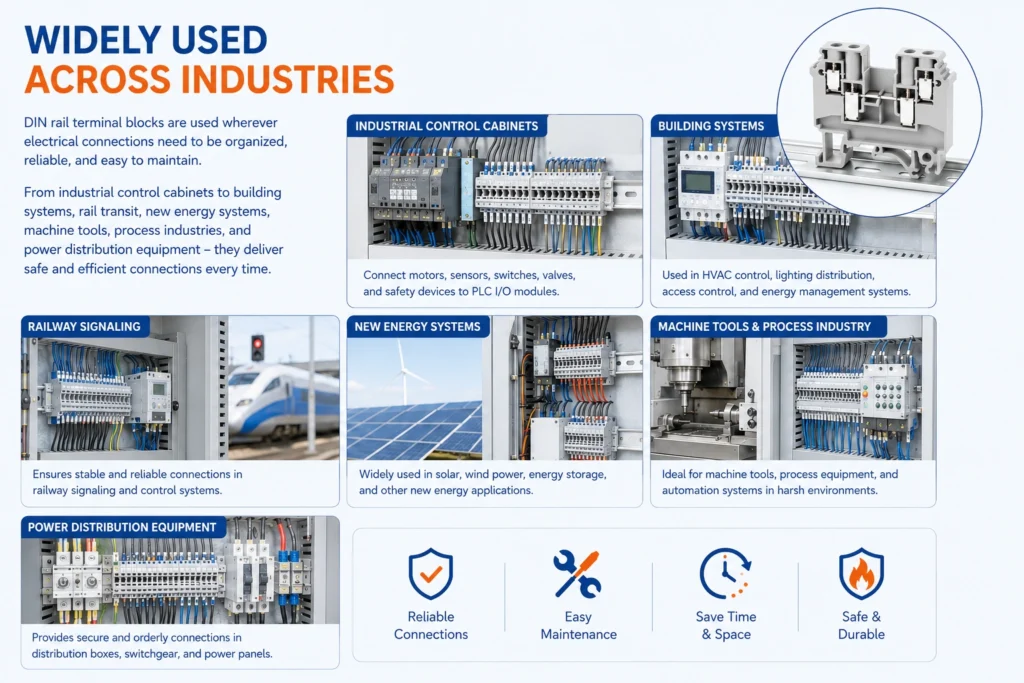
Their popularity is not based on novelty. It comes from repeatability. Designers can specify a known interface, panel builders can wire it efficiently, and maintenance teams can test or replace circuits without improvising. That consistency reduces the chance that a small wiring problem becomes a long production stoppage.
Why the Right DIN Rail Terminal Block Matters?
Return to the control cabinet from the opening of this article. The rows of gray blocks no longer look passive. Each DIN Rail Terminal Block defines where a circuit enters, how it is secured, how it is identified, and how it can be tested later. The rail provides order, the current bar provides the conductive path, and the clamping mechanism preserves the contact. Together, those simple parts turn complex field wiring into a system that people can understand and trust.
That is why a terminal block should never be treated as an afterthought. The right product, correctly selected and installed, protects connection quality today while making tomorrow’s expansion and troubleshooting faster. A DIN Rail Terminal Block works by joining wires, but its real contribution is larger: it makes the entire control panel safer to manage, easier to maintain, and more resilient over time.