A panel builder is preparing a new power distribution cabinet.
The feeder current is close to 200 A, so the purchasing request seems straightforward:
“Please find us a 200A terminal block.”
The buyer searches the catalog, compares current ratings and finds a terminal rated slightly above 200 A.
Problem solved?
Not necessarily.
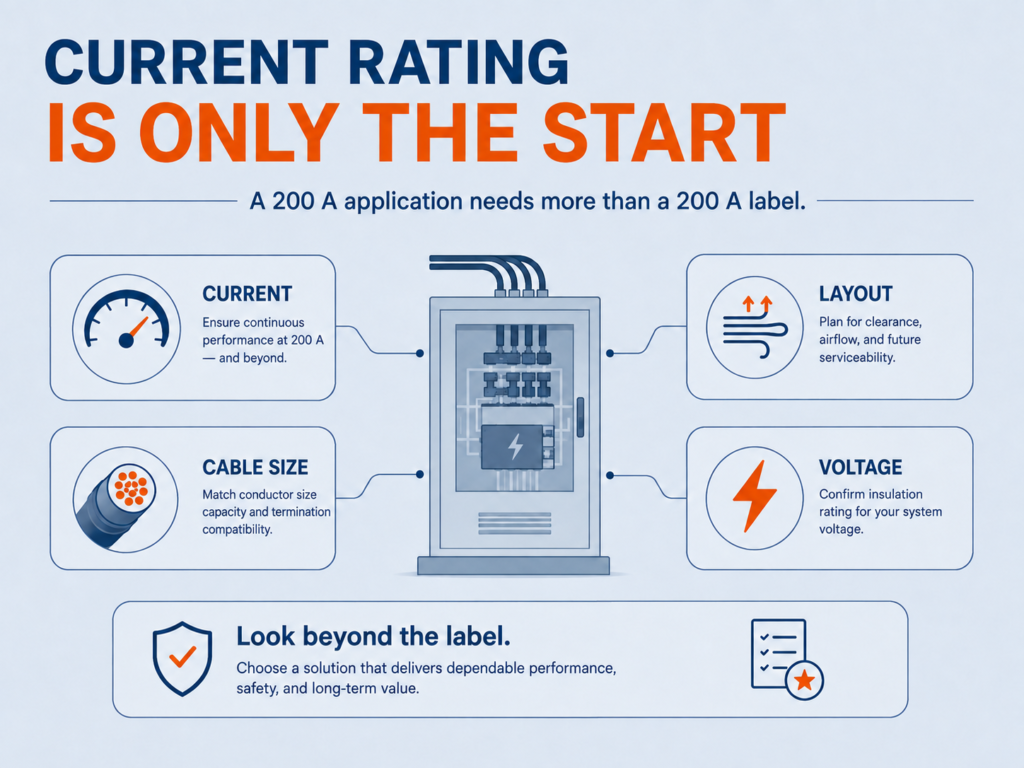
When the product reaches the wiring stage, several questions can suddenly appear:
- Does it accept the conductor size already specified for the project?
- Does the cabinet need one output or several outgoing connections?
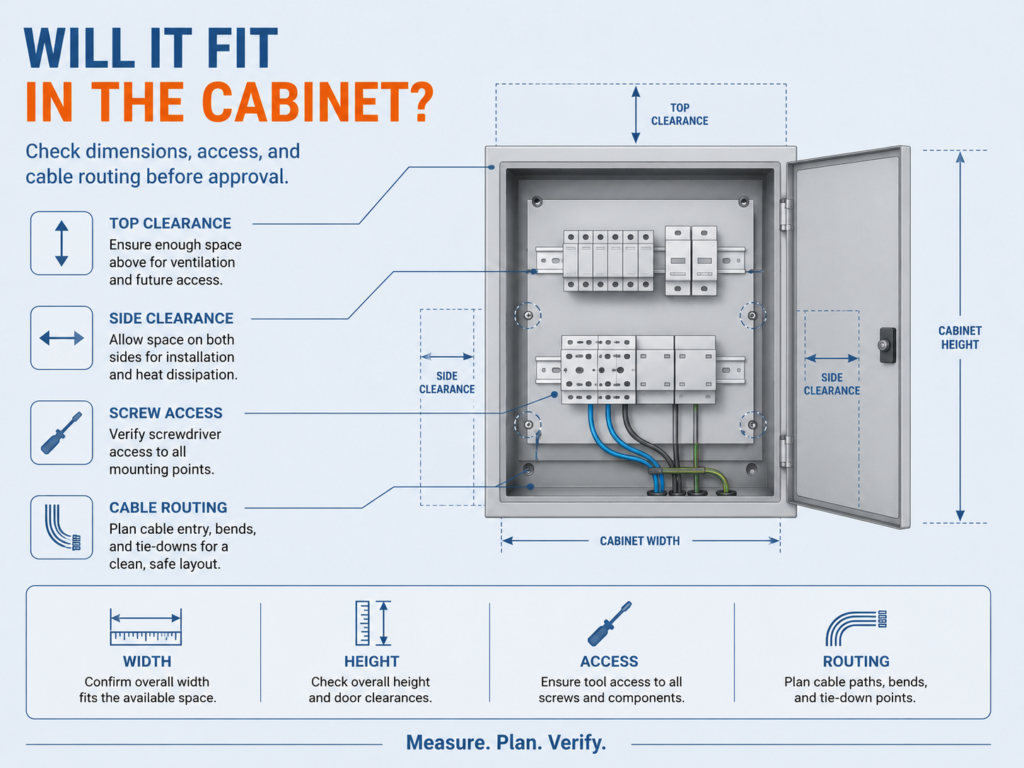
- Is there enough space for the terminal and the large cable?
- Can the installer easily access the connection screw?
- Is the voltage rating suitable?
- Would another terminal with exactly the same current rating actually fit the application better?
This is where a simple “200 A” purchasing requirement becomes a real engineering selection problem.
A 200 A rating tells you how to start searching. It does not tell you which terminal block to buy.
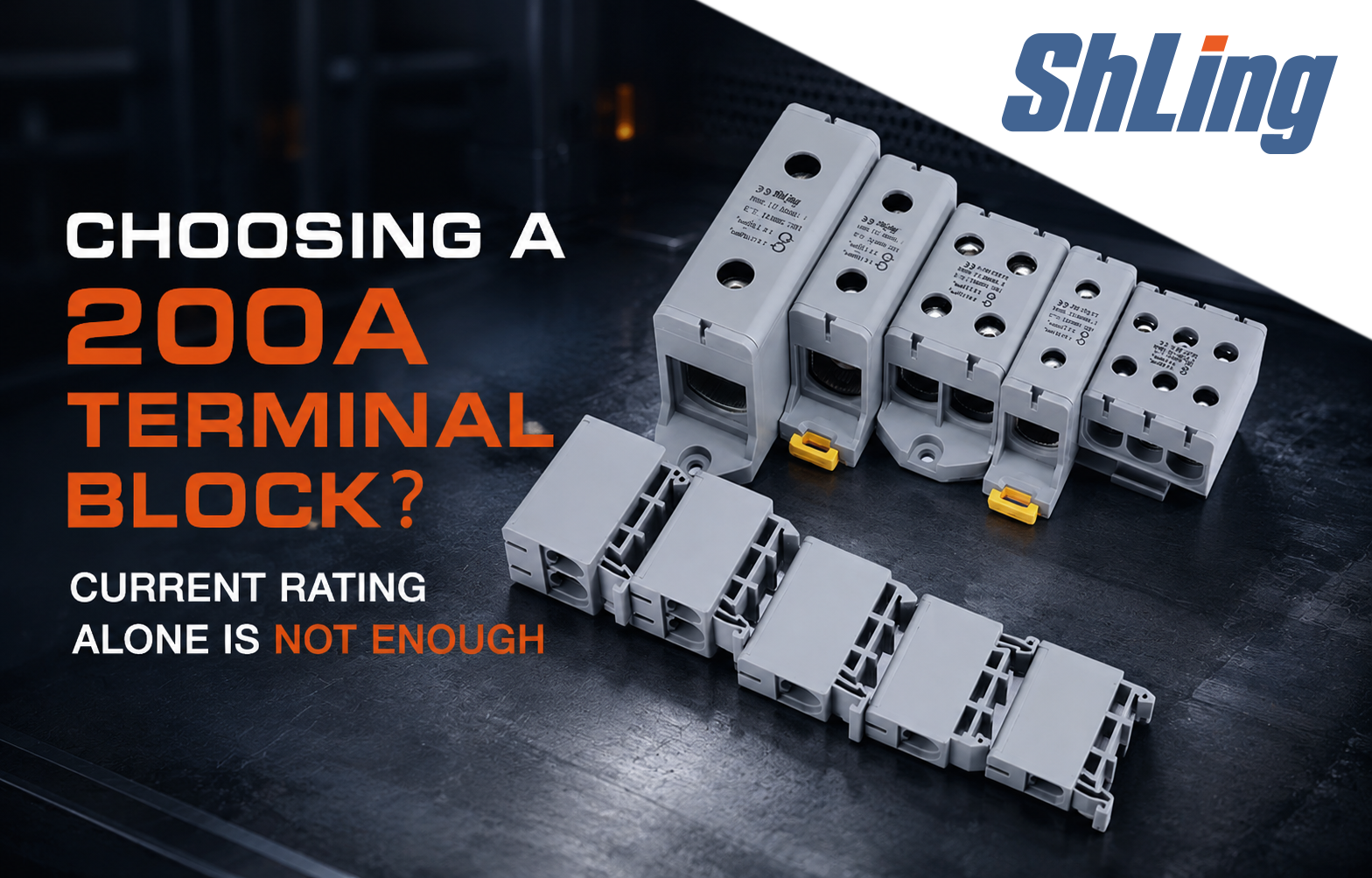
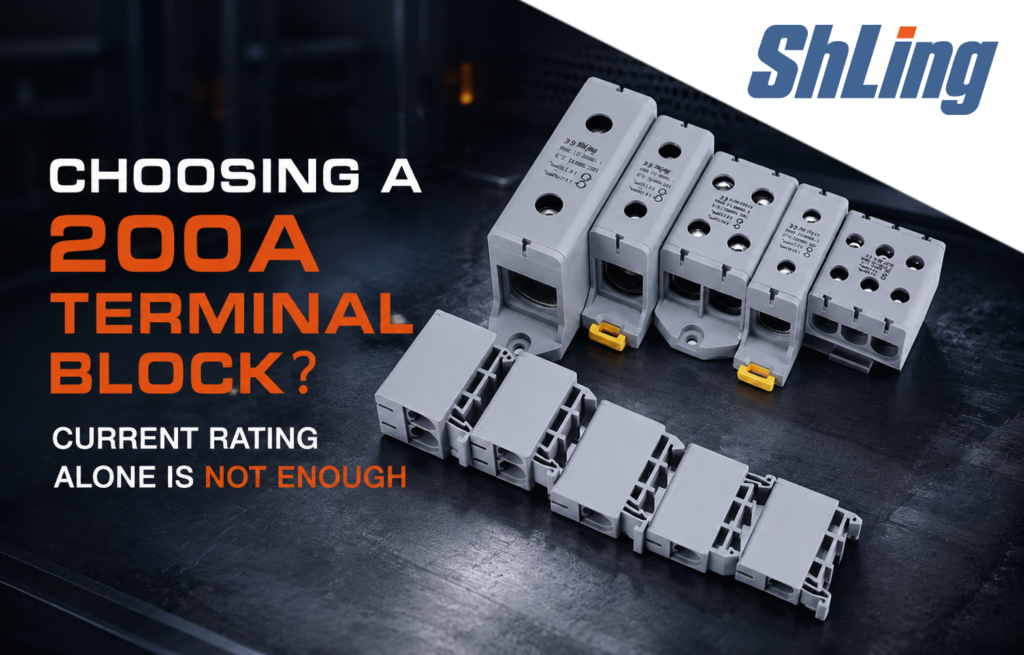
The SHLING SAL5 series provides a good real-world example.
For an application operating close to 200 A, you will not find one universal product simply called a “200A terminal block.” Instead, the SAL5 range includes different current levels, conductor sizes, connection arrangements and physical dimensions.
For example, SL7-SAL5-95 and SL7-SAL5-95-2 are both rated at 220 A and 800 V.
On paper, either one appears to have enough current capacity for a 200 A project.
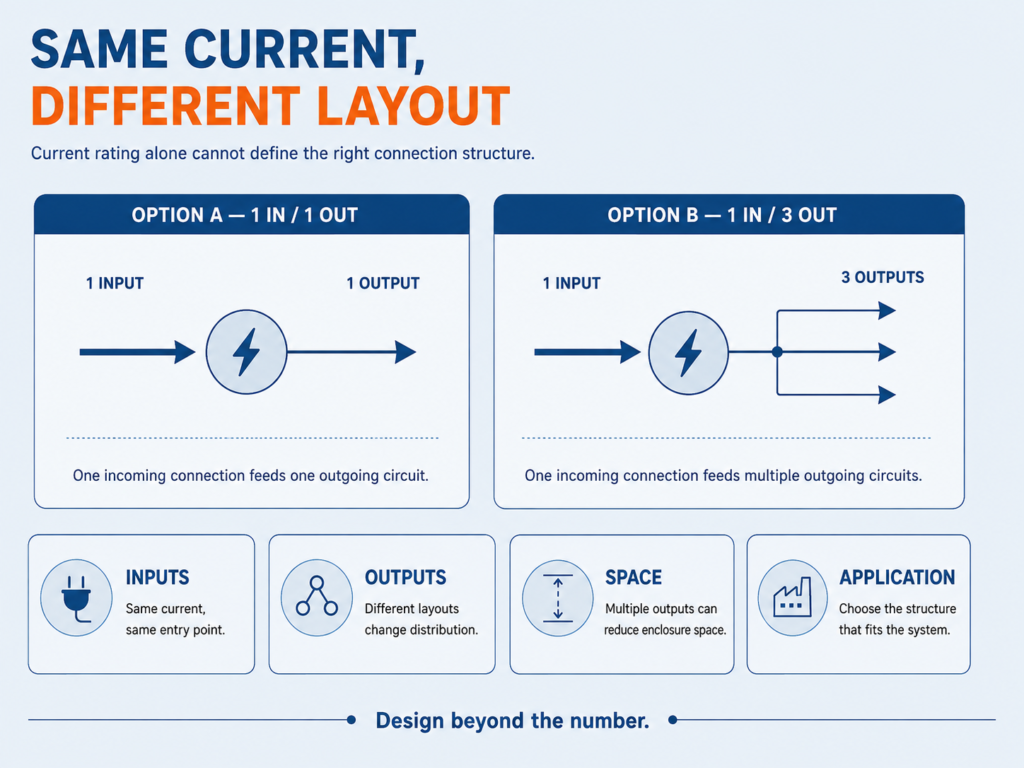
But one is a 1-in/1-out configuration. The other is 1-in/3-out.
Same current rating. Very different solution.
And that is the real issue this article will answer:
If the current rating looks correct, what else should you check before approving a high-current terminal block?
1. Start With the Actual Cable, Not the 200 A Number
One of the easiest sourcing mistakes is to treat current rating as the complete specification.
A request such as “We need a 200A terminal block” still leaves out one of the most important pieces of information:
What conductor will actually be connected to it?
According to the supplied SAL5 product data, different models are designed around very different conductor cross-sections.
| Model | Rated Current | Rated Voltage | Conductor Cross-Section |
| SL7-SAL5-16 | 63 A | 800 V | 16 mm² |
| SL7-SAL5-35 | 120 A | 800 V | 35 mm² |
| SL7-SAL5-50 | 145 A | 800 V | 50 mm² |
| SL7-SAL5-95 | 220 A | 800 V | 95 mm² |
| SL7-SAL5-240 | 380 A | 800 V | 240 mm² |
The pattern is clear. As the required current increases, conductor capacity becomes part of the selection—not an afterthought.
So before asking a supplier for a “200A terminal block,” provide the actual conductor cross-section as well.
A much better RFQ would be:
“Our operating current is approximately 200 A at 800 V. We use a 95 mm² conductor and require one incoming and one outgoing connection. Please recommend a suitable model.”
That gives the supplier something they can actually match.
2. The Same Current Rating Does Not Mean the Same Terminal
This is where the SAL5 series becomes especially useful as an example.
| Model | Rated Current | Conductor Cross-Section | Wiring Method | Dimensions |
| SL7-SAL5-50 | 145 A | 50 mm² | 1 in, 1 out | 17.8 × 50 × 43.3 mm |
| SL7-SAL5-50-2 | 145 A | 2 × 50 mm² | 1 in, 3 out | 31.8 × 50 × 43.3 mm |
| SL7-SAL5-50-3 | 145 A | 3 × 50 mm² | 1 in, 5 out | 44.8 × 50 × 43.3 mm |
All three are rated at 145 A. If the buyer compares only the current column, they look almost identical.
But from an installation point of view, they serve three different wiring layouts.
One provides a simple incoming-to-outgoing connection. One distributes the incoming supply to three outgoing positions. One provides five outputs.
That means a terminal block can have the correct current rating and still be completely wrong for the required circuit layout.
This is particularly important in power distribution applications.
The question is not only “How much current?” It is also “Where does that current need to go?”
3. For a 200 A Project, Compare the Connection Layout
Now return to the original 200 A example. The SAL5 data lists two 220 A models:
| Model | Rated Current | Voltage | Conductor Cross-Section | Screw | Wiring Method | Dimensions |
| SL7-SAL5-95 | 220 A | 800 V | 95 mm² | M14 | 1 in, 1 out | 24 × 91.4 × 49.2 mm |
| SL7-SAL5-95-2 | 220 A | 800 V | 2 × 95 mm² | M14 | 1 in, 3 out | 42 × 91.4 × 49.2 mm |
Both exceed a 200 A operating requirement on paper. But imagine two different cabinets.
Cabinet A
One incoming feeder enters the cabinet and continues to one outgoing connection. The 1-in/1-out configuration is the more relevant structure to evaluate.
Cabinet B
One incoming feeder must distribute power to three outgoing connections. The current is still around 200 A. The voltage is still 800 V. But now the 1-in/3-out configuration becomes much more relevant.
Nothing changed in the headline current requirement. Yet the suitable terminal configuration changed completely.
This is why searching by current alone can easily lead to the wrong quotation.
4. Check the Physical Size Before You Approve the Model
High-current terminal blocks do not exist by themselves inside a cabinet. They exist together with large conductors, cable ducts, breakers, busbars and neighboring components.
And large conductors need space.
The two 220 A SAL5 models show the issue clearly:
- SL7-SAL5-95: 24 × 91.4 × 49.2 mm
- SL7-SAL5-95-2: 42 × 91.4 × 49.2 mm
The multi-output model requires considerably more installation width. That may be acceptable in a large distribution cabinet. But inside a compact machine enclosure, an extra 18 mm can affect:
- Distance to cable ducts
- Cable bending space
- Clearance to breakers
- Screw access
- Neighboring terminals
- Overall cabinet layout
And the terminal dimensions are only part of the problem. You must also leave enough space to route the actual conductor into the terminal without forcing it into an unsuitable bend.
So instead of asking “Does this terminal fit?”, ask: “Does this terminal fit after the actual cable is connected?”
That is a much better engineering question.
5. Do Not Ignore the Connection Screw
The SAL5 product data also shows that the connection hardware changes as terminal capacity increases.
- SAL5-16: M6
- SAL5-35: M8
- SAL5-50 series: M10
- SAL5-95 series: M14
- SAL5-150: M18
- SAL5-240: M20
This matters because a large-current terminal must also be practical to install.
According to the supplied SAL5 product information, the series uses an internal hex socket screw connection. The installation process is straightforward:
1. Loosen the screw.
2. Insert the conductor.
3. Tighten the screw to complete the connection.
But the larger the terminal becomes, the larger the connection hardware becomes as well. Before approving a model, therefore, check whether the installer has enough access to the screw after the terminal and cable are positioned inside the cabinet.
Important: the supplied SAL5 sheet specifies screw sizes, but it does not provide tightening torque values. If your project requires a defined tightening torque, request the value for the exact model rather than estimating it.
6. Voltage Is a Separate Requirement
Another common mistake is to assume that once the current rating is high enough, the electrical selection is complete. It is not.
The SAL5 models shown in the supplied product data are rated at 800 V, while their current ratings range from 63 A to 380 A.
Current and voltage therefore need to be checked independently.
A simple purchasing rule is: check current and voltage separately before moving to conductor size and mechanical fit.
7. Do Not Automatically Choose a Much Larger Terminal “To Be Safe”
Another mistake can happen in the opposite direction.
Suppose the application requires around 200 A. The buyer sees 220 A, 240 A and 380 A and thinks: “Why not just buy the biggest one?”
Because larger does not automatically mean better.
Take the SAL5-240 as an example. It is listed at:
- 380 A
- 800 V
- 240 mm²
- M20 screw
- 36 × 130.7 × 66.7 mm
Compare that with the SAL5-95:
- 220 A
- 800 V
- 95 mm²
- M14 screw
- 24 × 91.4 × 49.2 mm
These are completely different physical connection solutions. Selecting a much larger terminal can mean more cabinet space, different conductor requirements, larger connection hardware, more difficult cable routing, and unnecessary cost or installation complexity.
The objective is not to choose the highest current rating available. It is to choose the smallest appropriate solution that satisfies the real electrical and mechanical requirements of the application.
8. What Does the SAL5 Construction Bring to High-Current Applications?
The SAL5 series is designed for large-current electrical connections rather than small control wiring.
According to SHLING’s supplied product information, the series uses a thickened conductive body, providing a large conductive cross-section while maintaining relatively low weight and corrosion resistance.
The housing uses PA66 nylon, selected for performance under demanding temperature and mechanical conditions. The product also uses the internal hex-screw connection described above.
These characteristics make the SAL5 family relevant for heavy-current power connection and distribution applications.
But product-family construction is still only one part of model selection. The correct SAL5 model must match the Current + Voltage + Conductor Size + Connection Layout + Installation Space of the actual project.
A Practical Example: Selecting a Terminal for a 200 A Cabinet
Consider the following project:
| Project Requirement | Specification |
| Operating current | Approx. 200 A |
| Operating voltage | 800 V |
| Conductor | 95 mm² |
| Wiring layout | 1 incoming / 1 outgoing |
| Cabinet | Limited space |
| Priority | Compact high-current connection |
Based on the supplied SAL5 data, SL7-SAL5-95 would be a logical model to evaluate:
- Rated current: 220 A
- Rated voltage: 800 V
- Conductor cross-section: 95 mm²
- Screw: M14
- Wiring method: 1 in, 1 out
- Dimensions: 24 × 91.4 × 49.2 mm
Now change only one requirement: the cabinet needs one incoming connection and three outgoing connections.
The current is still 200 A. The voltage is still 800 V. The conductor class is still based around the 95 mm² SAL5 configuration.
But the relevant model changes to SL7-SAL5-95-2, because its wiring layout is 1 in, 3 out.
A 200 A requirement does not identify a terminal block. It only identifies one part of the requirement.
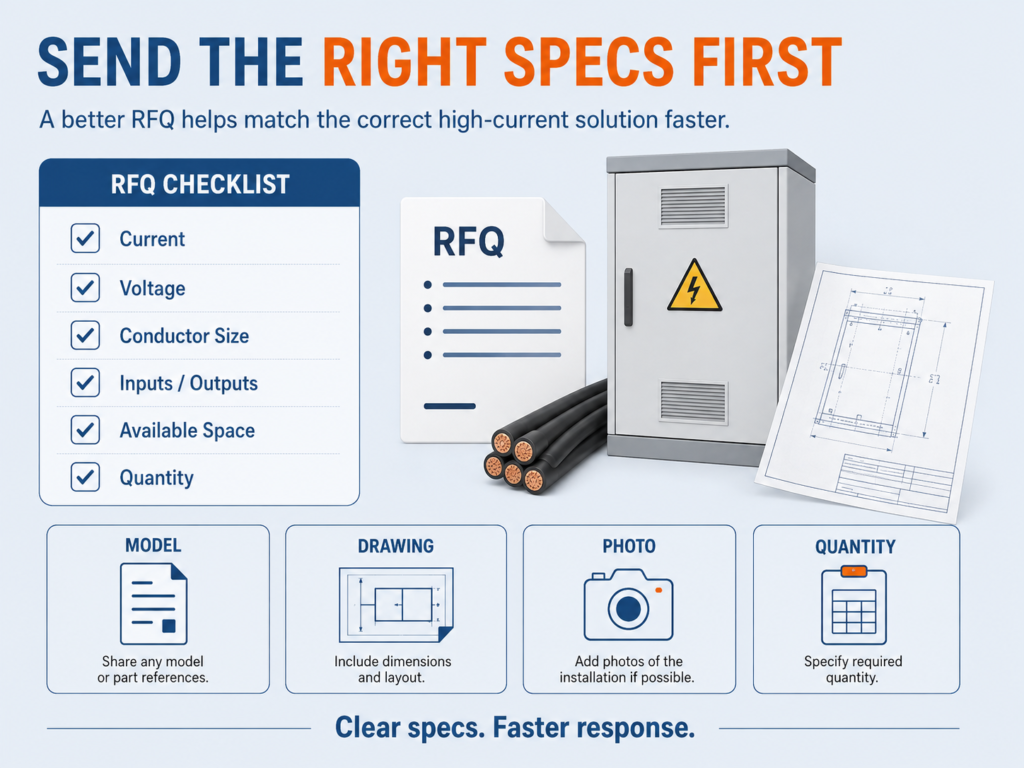
What Should You Send the Supplier?
You can avoid several rounds of emails by including the following information in your first RFQ:
| Information | Example |
| Operating current | 200 A |
| Operating voltage | 800 V |
| Conductor cross-section | 95 mm² |
| Wiring requirement | 1 in / 1 out |
| Available space | L × W × H |
| Existing product | Model / photo / drawing |
| Quantity | Sample / production quantity |
If you are replacing another brand, also send:
- Existing model number
- Front and side product photos
- Datasheet
- Dimensional drawing
This allows the supplier to compare the application rather than simply match a current number.
A 200 A Rating Is the Starting Point, Not the Final Answer
When a project requires approximately 200 A, searching for a 200A terminal block is a reasonable first step. But before approving the terminal, continue the comparison:
Current & Voltage → Conductor Size → Wiring Layout → Dimensions → Connection Hardware → Project Requirements
The SAL5 series demonstrates why this matters. Two models can have exactly the same current and voltage ratings but different numbers of outputs and different dimensions. And a higher-rated model can introduce a much larger conductor requirement and installation footprint.
So the real purchasing question should not be “Do you have a 200A terminal block?”
It should be: “Which terminal block matches my 200 A application?”
That difference can prevent the wrong product from reaching the assembly line.
Need Help Selecting an SAL5 High-Current Terminal?
Send SHLING these details:
Current | Voltage | Conductor Size | Number of Inputs/Outputs | Available Space | Quantity
If you are replacing an existing terminal, also send the model number, datasheet, drawing or clear product photo.
SHLING can use these details to narrow the SAL5 options and identify suitable models for sample evaluation before production.