1. Why Do Buyers Always Compare Screw Terminals and Spring Terminals?
In electrical connection systems, terminal blocks may look like small components, but they directly affect wiring efficiency, long-term stability, maintenance convenience, and overall purchasing cost. For buyers and traders, the choice between screw terminals and spring terminals is not simply about which one is better, but which one is more suitable for a specific project.
When selecting a terminal connector, customers usually care about several practical points: whether the connection is secure, whether it is suitable for high current applications, how efficient the installation process is, whether downstream customers will accept it easily, and whether it meets common European market expectations. Because these needs vary from project to project, both screw terminal blocks and spring terminal products continue to have their own clear application value.
2. What Are Screw Terminals and Spring Terminals?
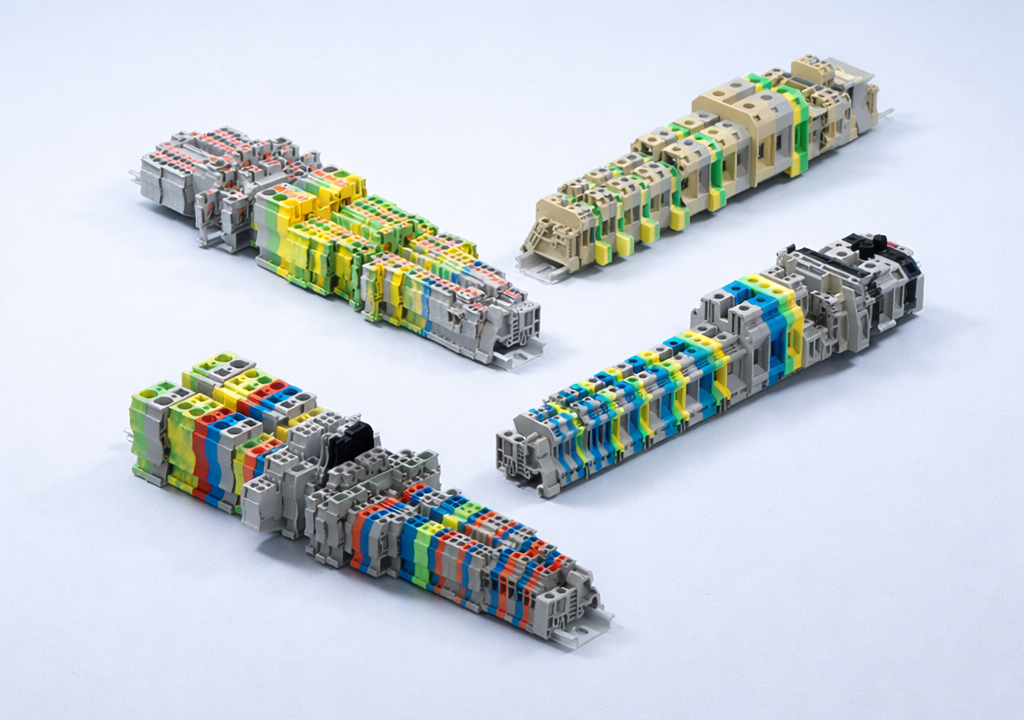
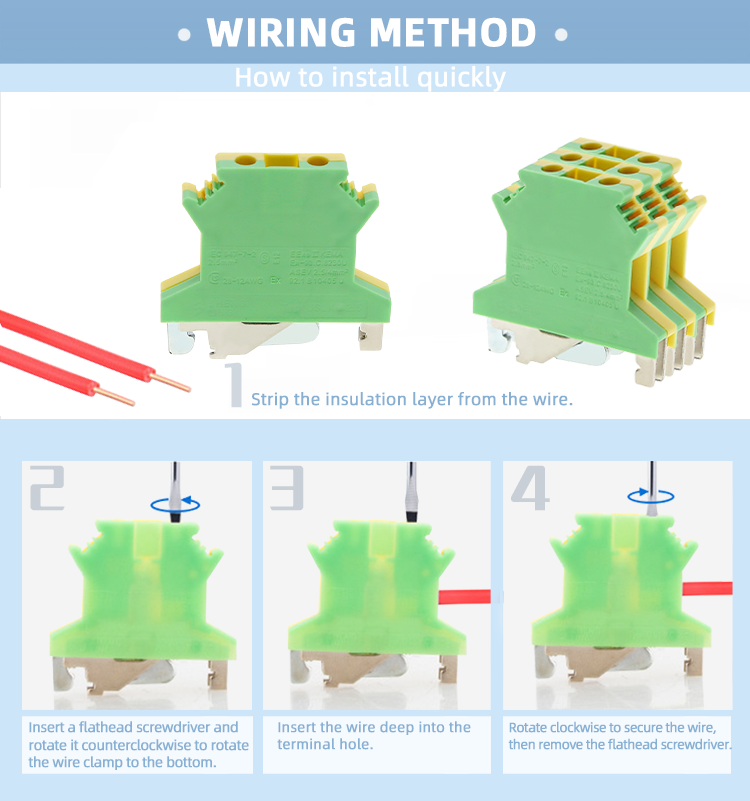
A screw terminal connects the conductor by tightening it with a screw. This structure is straightforward, familiar to many users, and widely used in traditional control cabinets, power distribution, and standard industrial wiring. Its main advantage is market acceptance, since many end users are already used to this connection method.
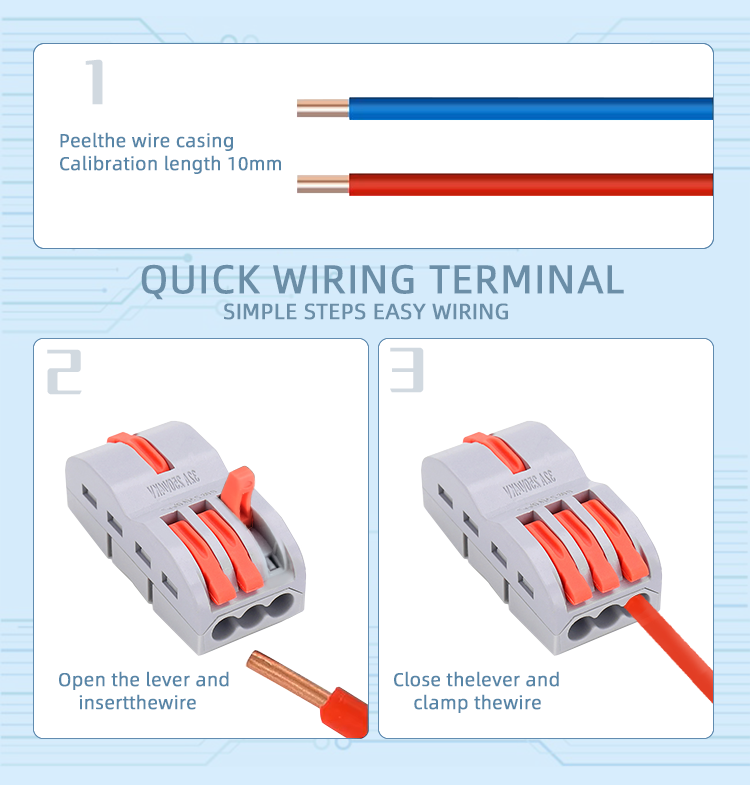
A spring terminal, by contrast, uses a spring mechanism to hold the conductor in place. Its key advantage is faster and more efficient wiring. It is especially suitable for batch installation, compact equipment, and standardized assembly work. In home appliances, small devices, and projects that require quick wiring, this kind of wiring terminal is becoming increasingly popular.
3. Screw Terminal vs Spring Terminal: A Clear Comparison
Screw terminals | Spring terminals | |
Tool Requirements | A screwdriver or electric driver is required, so installation is limited by tool access and available space. | Most types are tool-free or only require a simple pressing tool, making them more suitable for confined spaces. |
Vibration Resistance | Without anti-loosening measures, screws may gradually loosen under long-term vibration. | The spring automatically compensates for slight displacement, offering better resistance to vibration and mechanical stress. |
Contact Reliability | Depends on tightening torque and operator skill; insufficient tightening may cause overheating or poor contact. | Spring pressure remains constant, ensuring stable long-term contact pressure and more reliable performance. |
Current / Power Range | Traditionally covers a wider range, with more options for high current and large cross-section cables. | Mainly used for small to medium currents; high-current spring terminals are expanding, but available models are still relatively limited. |
Wiring Density | The structure is relatively bulky, which limits use in high-density and small-pitch applications. | Terminals can be made more compact, which is beneficial for high-density and modular terminal block designs. |
Installation Consistency | Relies on worker experience; over-tightening or under-tightening can lead to quality variation. | Contact pressure is ensured by the structure itself, resulting in higher consistency and more repeatable wiring quality. |
Maintenance and Rewiring | Tools are required for wire removal, so repeated disassembly and reinstallation are less efficient. | Wires can be inserted, removed, or pressed directly, making them suitable for frequent maintenance, rewiring, and testing scenarios. |
Cost Structure | Unit price is often slightly lower, with a clear advantage in upfront material cost. | Unit price is higher, but labor and maintenance time costs can be reduced. |
4. Advantages and Limitations of Screw Terminals
The main advantage of screw terminal blocks is that the connection method is easy to understand and widely accepted by customers. They are especially suitable for traditional industrial projects and for users who are used to screw-lock wiring methods. In many control cabinets and power distribution applications, they are still a common choice.
Their limitation is also clear: installation usually takes more steps, so in large wiring projects, they are often less efficient than a quick connector or push-in type solution. If a project places more value on assembly speed, clean wiring, and installation efficiency, screw terminals may not always be the best option.
5. Advantages and Limitations of Spring Terminals
The biggest advantage of spring terminal products is speed. They support faster connections, higher wiring efficiency, and are better suited for standardized processes. For home appliance equipment, compact devices, and batch assembly projects, this benefit becomes especially noticeable.
The limitation is that some customers are still more familiar with traditional screw structures. When introducing a spring terminal or quick terminal solution, suppliers often need to explain rated parameters, wire range, and certifications more clearly. In some traditional high-current projects, customers may still prefer screw terminals first.
6. Five Key Questions Buyers Usually Ask
6.1. Is the Connection of a Spring Terminal Secure?
This is one of the most common buyer questions. A professional answer is not to claim that one type is always stronger, but to look at the actual application. As long as the product is selected correctly, the parameters match, and installation follows the proper standard, both screw terminals and spring terminals can provide a reliable connection.
In practice, connection reliability depends more on conductor size, rated parameters, operating environment, and product consistency than on the structure alone. So when comparing terminal blocks, buyers should focus on application fit rather than only on the connection method.
6.2 How Should Buyers Evaluate Cost?
Cost should not be judged by unit price alone. A better approach is to consider total cost, including product cost, installation labor, maintenance, and replacement convenience.
For projects involving a large amount of wiring, spring quick-connect products often offer better overall value because of higher installation efficiency. A screw terminal may be easier to compare by price, but once labor and wiring speed are included, the advantage of a quick-connect wire connector becomes more visible.
6.3 Can Spring Terminals Handle High Current?
This cannot be answered in a general way. High current capability depends on the specific series and rated value, not simply on whether the product is a screw terminal or a spring terminal.
Traditionally, screw terminals are more common in high-current and power-distribution projects, while quick-connection products are more suitable within their rated range and in standardized applications. That is why buyers should evaluate the exact model specifications instead of making assumptions based only on structure.
6.4 Are They Suitable for European Market Standards?
For customers in Eastern Europe and other European markets, certifications, materials, and product consistency are just as important as the product itself. Buyers often pay attention to rated voltage, rated current, insulation material, conductor material, supply stability, and factory qualifications.
6.5 Will Downstream Customers Accept Them Easily?
From a market perspective, PCT quick-connect terminals are becoming easier to accept, especially in home appliance equipment, compact devices, fast assembly projects, and applications that require higher efficiency. However, they also have clear application boundaries and do not simply replace all traditional screw terminal products.
7. If You Care More About Fast Installation and Home Appliance Applications, PCT Quick Connect Terminals Are Worth Considering
If a project places greater emphasis on quick connection, fast wiring, and home appliance applications, PCT quick-connect terminals warrant serious consideration. According to the SLTerminal catalog you provided, the PCT series belongs to the Spring-Fast Connector range and includes multiple pole options, different housing styles, and various application forms. This makes it a practical entry point for customers looking for a spring terminal, wiring connector, cable connector, or compact quick connector solution.
In applications where users value quick wiring, compact structure, and convenient installation, PCT products can serve as a practical alternative to traditional terminal blocks. For many buyers, especially those supplying appliance-related markets, this makes PCT a useful product direction.
8. Conclusion: There Is No Absolutely Better Terminal, Only a More Suitable One
Overall, screw terminals offer advantages in tradition, simplicity, and broad market acceptance. Spring terminals offer advantages in speed, efficiency, and suitability for standardized wiring and appliance-related applications. There is no absolutely better solution; the right choice depends on the actual application.
If you are looking for a wire connector, quick connector, spring terminal, or PCT quick connect solution for home appliances or fast wiring projects, you are welcome to send an inquiry and get more product information and selection support for the PCT series.
Point bottom connection, one-click shearing PCT rapid connection terminal:
PCT/SL/EU Series Spring Quick Connectors – Shengling Terminals